
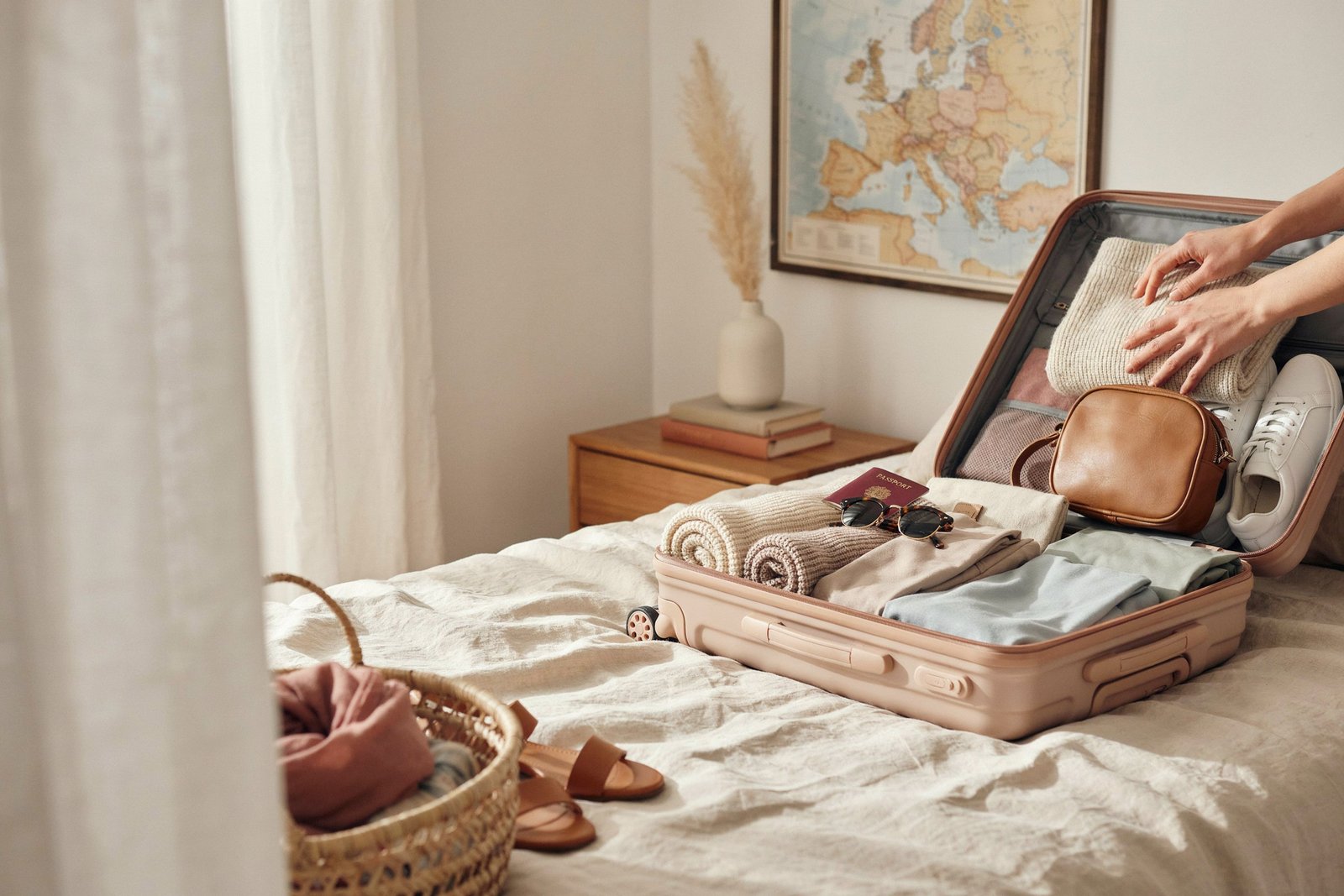

Packing for a 12-day trip used to make me feel like I needed to bring half of my closet with me. I would stare at my suitcase, wondering how I could possibly fit everything I might need without checking a bag.
Over time, though, I learned that packing light isn’t about taking less care with what you bring it’s about being smarter with every item.
With the right clothing combinations, a few space-saving tricks, and a little planning, traveling for nearly two weeks with only a carry-on is completely possible.
In this guide, I’ll show you exactly how I approach packing for 12 days, what I prioritize, what I leave behind, and how to make a small suitcase feel surprisingly spacious.
Shop my amazon essentials
- Carry-on suitcase
- Packing cubes
- Travel-size toiletry bag
- Comfortable walking shoes
- Portable power bank
- Universal travel adapter
- Reusable water bottle
- Crossbody travel bag
- Foldable daypack
Why Pack for 12 Days Without Checking a Bag?

Traveling with only a carry-on can completely change the way you experience a trip.
You don’t have to wait at baggage claim after a long flight. You won’t have to worry as much about your suitcase being delayed or misplaced. And when you arrive at your destination, you can simply grab your bag and start your adventure.
For me, one of the biggest benefits is convenience. A smaller suitcase is easier to carry through airports, train stations, hotel lobbies, and city streets.
It also encourages me to pack pieces that actually work together instead of bringing clothes “just in case.”
The secret isn’t owning an incredibly small wardrobe. It’s packing strategically.
For a 12-day trip, your goal should be to create a small travel wardrobe that can be mixed, matched, layered, and reworn.
Start With Your Trip, Not Your Suitcase
Before putting a single item into your carry-on, look at your itinerary.
Ask yourself:
- Where am I going?
- What will the weather be like?
- Will I be walking a lot?
- Will I have access to laundry?
- Are there dressy dinners or special activities?
- Will I visit more than one destination?
- What kind of shoes will I actually need?
- Will I need clothing for beaches, hiking, sightseeing, or cooler evenings?
This step can save you from one of the biggest packing mistakes: packing for every possible situation instead of the trip you’re actually taking.
If you’re visiting a warm destination for 12 days, you probably don’t need three sweaters. If you’re traveling somewhere cool, you may be better off with layers instead of bulky coats.
Your itinerary should determine your packing list.
The 12-Day Carry-On Packing Formula
Instead of thinking, “I need 12 outfits,” think in terms of a small capsule wardrobe.
A practical starting point for a 12-day trip could look like:
Clothing
- 5–7 tops
- 3–4 bottoms
- 1–2 dresses or jumpsuits
- 1 lightweight sweater or cardigan
- 1 versatile jacket
- 1 comfortable travel outfit
- 7–9 pairs of underwear
- 4–6 pairs of socks
- 2–3 bras
- 1–2 sleepwear options
- 1 swimsuit if needed
- 1 lightweight scarf or wrap
You don’t necessarily need exactly these numbers. Think of them as a starting point that you can adjust according to your destination.
The most important rule is this:
Every clothing item should work with several other pieces.
If a top only matches one pair of pants, it may not deserve valuable space in your carry-on.
Read How to Pack for 10 Days in Asia (Complete Travel Packing Guide)
Choose a Color Palette Before You Pack
This is one of my favorite tricks for avoiding overpacking.
Choose two or three main colors and build your travel wardrobe around them.
For example:
Neutral palette:
- Black
- White
- Beige
- Denim
Or:
Soft feminine palette:
- Cream
- Tan
- Light blue
- Blush
Or:
Classic travel palette:
- Navy
- White
- Gray
- Black
When most of your clothes coordinate, you can create many different outfits without bringing many individual pieces.
A simple black skirt, for example, could be worn with a white blouse, casual T-shirt, sweater, or lightweight tank top.
Suddenly, one item becomes several outfits.
Pack Clothes That Can Be Worn More Than Once
One of the biggest mindset shifts I made when learning to pack light was realizing that repeating clothes is completely normal when traveling.
You don’t need 12 completely different outfits.
A pair of jeans can be worn several times. A cardigan can be worn over multiple tops. A simple dress can work for sightseeing during the day and dinner at night with different accessories.
Instead of packing:
12 days = 12 outfits
Try thinking:
12 days = 5–7 tops + 3–4 bottoms + layers + accessories
That’s where the magic happens.
Build a Simple Capsule Wardrobe
Here’s an example of how you could create a 12-day travel capsule.
Tops
Choose:
- 2 basic T-shirts
- 2 nicer tops
- 1 button-down shirt
- 1 lightweight blouse
- 1 tank top
Bottoms
Choose:
- 1 pair of comfortable jeans
- 1 lightweight pair of trousers
- 1 skirt or shorts
- 1 versatile pair of pants
Dresses
Add one or two dresses if they fit your destination.
A simple midi dress can be incredibly useful because it can be dressed up or down.
Layers
Bring:
- 1 cardigan or lightweight sweater
- 1 jacket
If you’re traveling somewhere cold, substitute heavier layers while still focusing on pieces that work together.
Read Packing List For Paris For Every Season (Effortless & Chic Year-Round Guide)
Wear Your Bulkiest Items on the Plane
Your carry-on has limited space, so don’t waste that space on your heaviest clothing.
If you’re traveling somewhere cool, wear:
- Your jacket
- Sneakers or boots
- Sweater
- Jeans
- Scarf
You can always remove layers once you’re seated.
This technique is especially helpful when traveling with a small carry-on because shoes and outerwear can take up a surprising amount of space.
Just make sure you’re still comfortable during the journey.
Shoes: Keep Them to Two or Three Pairs
Shoes are one of the easiest ways to overpack.
For most 12-day trips, I would aim for two versatile pairs, with a third only if your itinerary genuinely requires it.
A simple combination could be:
1. Comfortable walking shoes
These are essential for sightseeing days.
Choose something you’ve already worn and know is comfortable.
2. Versatile dressier shoes
These could work for restaurants, evenings, or occasions where sneakers don’t feel appropriate.
3. Optional sandals or specialized footwear
Only add a third pair if your destination requires it.
For example, beach trips may justify sandals, while hiking trips may require proper hiking footwear.
Don’t bring five pairs of shoes because you “might” wear them.
Use Packing Cubes Strategically
Packing cubes can make a carry-on much easier to organize.
Instead of throwing everything into one large compartment, divide your belongings into categories.
For example:
Cube 1: Tops
Cube 2: Bottoms and dresses
Cube 3: Underwear and sleepwear
Cube 4: Accessories or miscellaneous items
This makes it easier to find what you need without completely unpacking your suitcase.
Packing cubes also help keep your clothes organized when you’re moving between multiple hotels.
A helpful trick is to avoid filling every cube completely. Leave a little room so you can rearrange things when necessary.
Roll, Fold, or Bundle?
You’ll often hear that rolling clothes is always better than folding them.
The truth is that both methods can work.
I like using a combination.
Roll:
- T-shirts
- Tank tops
- Lightweight dresses
- Sleepwear
- Casual clothing
Fold:
- Blouses
- Structured clothing
- Jackets
- Items that wrinkle easily
You can also use compression packing cubes for certain clothing, but don’t compress everything simply because you can. Extremely compressed clothes can become difficult to organize and may wrinkle more.
The best packing method is the one that allows you to see and access your belongings easily.
Your Personal Item Is Part of Your Packing Strategy
Don’t forget that your personal item can provide valuable extra space.
Depending on your airline’s rules, this could be a backpack, tote, or smaller travel bag.
Use it for things you’ll want during the journey and items that don’t need to be inside your suitcase.
For example:
- Passport and travel documents
- Wallet
- Phone
- Chargers
- Headphones
- Small toiletries
- Medication
- Snacks
- Reusable water bottle
- E-reader or book
- Travel pillow
- Small electronics
Keep your most important items in your personal item rather than your carry-on suitcase.
Keep Your Toiletries Small
Toiletries can quietly take over an entire suitcase.
The solution is simple: downsize everything.
Instead of bringing full-size bottles, use appropriately sized travel containers where permitted.
You can also look for compact versions of products you use regularly.
Think about:
- Shampoo
- Conditioner
- Face cleanser
- Moisturizer
- Sunscreen
- Toothpaste
- Hair products
- Body wash
- Skincare products
Before packing something, ask:
“Will I use enough of this during 12 days to justify the space?”
If the answer is no, leave it behind.
And remember to follow your airline’s current rules for liquids and other restricted items before flying.
Don’t Pack Your Entire Skincare Routine
This one can be difficult, especially if you have a detailed skincare routine.
But travel is not the time to bring every product sitting on your bathroom shelf.
Choose the essentials.
For example:
- Cleanser
- Moisturizer
- Sunscreen
- One or two treatment products you genuinely need
The same applies to makeup.
Instead of bringing a full makeup collection, choose a small group of products that can create your everyday travel look.
A compact makeup bag is much easier to manage than a collection of individual products.
Make a Mini Hair Kit
Hair tools can take up a lot of space.
Before bringing a curling iron, straightener, blow dryer, and several brushes, check whether your accommodation provides a hair dryer.
If it does, leave yours at home.
For a 12-day trip, you may only need:
- Hairbrush or comb
- Hair ties
- Clips
- One styling tool if necessary
- Small amount of styling product
If you’re traveling internationally, remember to check electrical compatibility and voltage requirements for your devices.
Bring Travel-Size Laundry Supplies
This is one of the biggest secrets to making a 12-day carry-on trip possible.
You don’t necessarily need 12 days of clothing if you’re willing to wash a few things.
You don’t need to do a full load of laundry every few days.
A few lightweight items can be washed in a sink or at your accommodation and left to air dry.
Pack a tiny laundry bag to separate worn clothing from clean clothing.
You can also plan your trip around a hotel or accommodation with laundry facilities if that is convenient.
Washing a few basics halfway through your trip can dramatically reduce how much clothing you need.
The “Wear, Wash, Repeat” Strategy
For a 12-day trip, think of your clothing in cycles.
For example:
Days 1–4: Wear your first group of outfits.
Day 5: Wash a few basics.
Days 6–9: Rotate your pieces.
Day 10: Wash again if needed.
Days 10–12: Finish with clean combinations.
This works particularly well with lightweight fabrics that dry quickly.
It’s also useful for longer trips when you want to travel with the same amount of luggage.
Accessories Can Make Repeating Outfits Feel Different
You don’t need more clothes to create variety.
Accessories can completely change a simple outfit.
Consider packing:
- 1 lightweight scarf
- 1 belt
- 1 pair of sunglasses
- 1 small crossbody bag
- 1 simple necklace
- 1 pair of earrings
- 1 versatile hat
A basic outfit can look completely different simply by changing the accessories.
The trick is to choose accessories that work with multiple outfits.
Pack a Small Travel Emergency Kit
You don’t need a giant emergency bag.
A small pouch can hold useful basics such as:
- Bandages
- Blister protection
- Small sewing kit
- Stain-removal wipes
- Safety pins
- A few personal care essentials
- Any medications you normally take
Keep it compact and practical.
The goal isn’t to prepare for every imaginable situation. It’s to handle the small inconveniences that commonly happen while traveling.
Keep Electronics Under Control
Electronics can become surprisingly bulky.
Before packing, ask yourself what you genuinely need.
For many travelers, this might include:
- Smartphone
- Charging cable
- Wall adapter
- Power bank
- Headphones
- Camera, if you use one
You probably don’t need multiple sets of headphones, several charging cables, and every gadget you own.
If one device can perform several functions, let it.
Your phone can often serve as your camera, map, entertainment device, travel guide, and communication tool.
Don’t Forget Your Travel Documents
Your important documents should be easy to reach.
Keep them together in a small travel wallet or organizer.
Depending on your trip, you may need:
- Passport
- Visa or entry documents if required
- Boarding information
- Hotel information
- Travel insurance information
- Emergency contact information
- Copies of important documents
Keep digital backups where appropriate, but don’t rely exclusively on your phone.
What I Would Leave at Home
When I pack for a longer trip with only a carry-on, I pay just as much attention to what I don’t bring.
I’d usually leave behind:
- Extra shoes
- Full-size toiletries
- Multiple heavy jackets
- Too many accessories
- “Maybe I’ll wear this” outfits
- Clothes that only work with one item
- Large books
- Bulky towels
- Excessive beauty products
- Duplicate electronics
- Clothing that is uncomfortable
- Anything I haven’t worn in a long time
If you wouldn’t normally wear it at home, chances are you won’t suddenly want to wear it on vacation.
My Favorite 12-Day Packing Rule: The One-Week Test
Here’s a simple trick I love.
Pretend you’re only packing for seven days.
Then add only the items that make sense for extending the trip to 12 days.
Instead of adding five more complete outfits, add a few extra underwear, another top, and perhaps another versatile bottom.
This forces you to think about what you actually need rather than automatically packing one outfit per day.
A Sample 12-Day Carry-On Wardrobe
Here’s an example you can customize:
Clothing
- 2 basic T-shirts
- 2 elevated tops
- 1 blouse
- 1 button-down shirt
- 1 tank top
- 1 pair of jeans
- 1 pair of lightweight trousers
- 1 skirt or shorts
- 1 versatile pair of pants
- 1 casual dress
- 1 nicer dress
- 1 cardigan
- 1 lightweight jacket
- 8 pairs of underwear
- 5 pairs of socks
- 2–3 bras
- 1–2 sleepwear sets
- 1 swimsuit
Shoes
- Comfortable walking sneakers
- Dressier flats or shoes
- Optional sandals depending on destination
Accessories
- Sunglasses
- Belt
- Scarf
- Small jewelry pouch
- Crossbody bag
Toiletries
- Toothbrush
- Toothpaste
- Skincare basics
- Sunscreen
- Hairbrush
- Deodorant
- Minimal makeup
- Travel-size hair products
Travel essentials
- Passport
- Wallet
- Phone
- Chargers
- Power bank
- Travel documents
- Reusable water bottle
- Small laundry bag
- Packing cubes
How to Fit Everything Into Your Carry-On
Start by placing your packing cubes or clothing at the bottom of your suitcase.
Put heavier items toward the bottom near the wheels.
Then add:
- Bottoms
- Tops
- Dresses
- Underwear
- Sleepwear
- Lightweight layers
- Accessories
Place shoes along the edges or in shoe bags.
Use the small spaces inside shoes for socks or other tiny items.
Place toiletries in an easily accessible section, especially if you’ll need to remove them during airport security.
Finally, use the suitcase’s compression straps to secure everything.
Don’t force the zipper closed.
If you’re struggling to close the suitcase, that’s usually a sign that something needs to come out.
The Final Packing Test
Before leaving home, do one final test.
Close your suitcase completely.
Then carry it around your home for a few minutes.
Lift it.
Walk with it.
Place it on the floor.
Put it into a car trunk if you’ll be traveling that way.
If it already feels frustrating at home, imagine carrying it through a busy airport or train station.
This is when I usually discover that I packed something I don’t actually need.
What to Do If Your Carry-On Is Too Full
Don’t immediately buy a larger suitcase.
First, remove everything and sort it into three piles:
Absolutely necessary
Things you definitely need.
Nice to have
Things you would enjoy having but could live without.
“Just in case”
Things you packed because you imagined a situation that probably won’t happen.
The third pile is usually where the biggest space savings are hiding.
Start removing from there.
Packing for Different Types of 12-Day Trips
Your packing strategy should change depending on where you’re going.
For a European City Trip
Prioritize:
- Comfortable walking shoes
- Neutral clothing
- Lightweight layers
- Crossbody bag
- Compact umbrella if needed
- One nicer outfit
You’ll probably be walking much more than you expect, so comfortable footwear matters.
For a Beach Vacation
Prioritize:
- Swimsuits
- Lightweight dresses
- Sandals
- Sun protection
- Breathable clothing
- Small beach bag
Don’t bring excessive heavy clothing.
For a Hiking Trip
Prioritize:
- Proper footwear
- Moisture-managing clothing
- Layers
- Weather protection
- Small first-aid essentials
- Reusable water bottle
For outdoor adventures, functionality should come before fashion.
For a Cold-Weather Trip
Cold-weather packing requires more strategy because sweaters and coats can quickly consume your carry-on.
Focus on:
- Base layers
- One warm mid-layer
- One outer layer
- Comfortable pants
- Weather-appropriate shoes
- Accessories such as a hat and gloves
Wear your bulkiest outerwear during transit whenever practical.
Common Carry-On Packing Mistakes
Packing for every possible weather condition
Check the forecast before you leave and build around realistic conditions.
Bringing too many shoes
Most travelers can get by with fewer shoes than they think.
Packing individual outfits
Choose mix-and-match pieces instead.
Bringing full-size toiletries
Downsize wherever practical.
Ignoring laundry
A little laundry can save a lot of suitcase space.
Packing uncomfortable clothes
Travel isn’t the time to test a new pair of shoes or an outfit you aren’t sure about.
Forgetting your personal-item allowance
Your personal item can help distribute your essentials.
Waiting until the night before
Packing at the last minute often leads to overpacking.
A Simple 12-Day Packing Timeline
I like starting early rather than trying to squeeze everything into a suitcase the night before.
One Week Before
Check:
- Weather
- Itinerary
- Airline baggage rules
- Accommodation amenities
- Laundry availability
- Planned activities
Three Days Before
Choose your clothing capsule and check that everything is clean.
Two Days Before
Pack toiletries, electronics, accessories, and documents.
The Night Before
Pack your final clothing pieces and travel outfit.
Before Leaving
Do one final check of:
- Passport
- Phone
- Wallet
- Keys
- Chargers
- Medication or personal essentials
- Travel documents
- Suitcase
- Personal item
Final Thoughts
Packing for 12 days without checking a bag might sound intimidating at first, but once you stop thinking in terms of one outfit for every day, it becomes much easier.
The goal isn’t to squeeze your entire life into a tiny suitcase. It’s to create a practical collection of pieces that work together, prioritize what you’ll actually use, and leave behind the things you’re only bringing “just in case.”