
Why Cape Town is a World-Class Hiking City
Few cities fuse wild mountain, Atlantic coastline, fynbos biodiversity, and a vibrant urban scene as seamlessly as Cape Town.
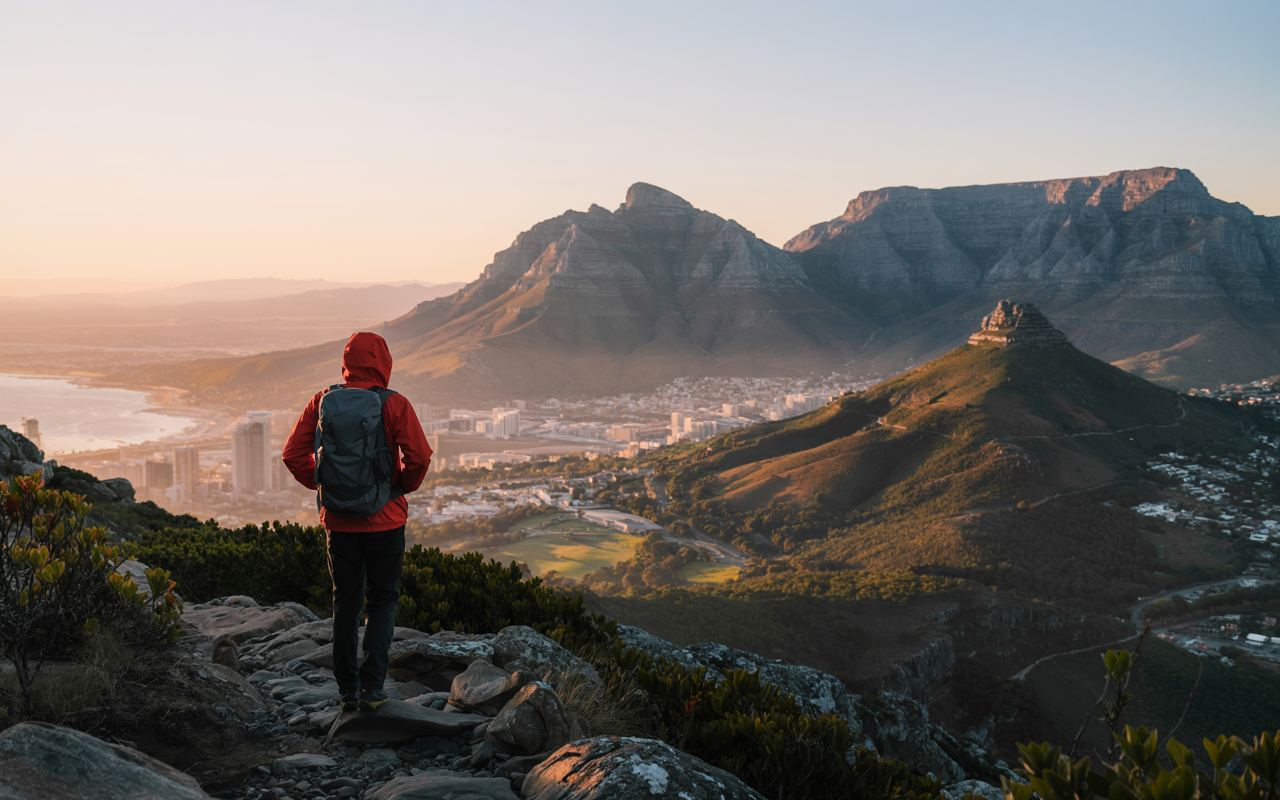
The Table Mountain massif sits in the heart of the city, with serrated ridgelines, sandstone cliffs, valleys shaded by indigenous forest, and airy summits overlooking two oceans.
Trails range from friendly, family-ready paths to steep scrambles with chains and ladders.
Weather changes fast, the sun can be fierce, and the wind (the “Cape Doctor”) often howls yet on a good day, there’s nowhere quite like it.
This guide focuses on four trails that, together, give you the full Cape Town experience: a sunrise/sunset classic, a direct climb up the city’s crown, a forested gorge route to the true high point, and a dramatic west-side ascent to an iconic rock ledge.
They’re popular for good reason and with the right preparation, they’re unforgettable.
At-a-Glance: The Four Hikes
- Lion’s Head – Cape Town’s social summit: a helical path around a freestanding peak with 360° views over Table Mountain, Camps Bay, and the City Bowl. Optional chains/ladders add spice; a walk-around variation keeps it friendly.
- Table Mountain via Platteklip Gorge – The straight-up classic: the most direct stair-stepping ascent to the Table Top. Steep, exposed, and a cardio test—but the quickest way to earn Table Mountain.
- Skeleton Gorge to Maclear’s Beacon – A shaded, forested scramble from Kirstenbosch Botanical Garden up a boulder-strewn gorge to the highest point of the massif, with a rewarding traverse across the tabletop.
- Kasteelspoort (Twelve Apostles) to the “Diving Board” – The grand west-face route: big mountain vibes, dramatic sandstone buttresses, Atlantic panoramas, and a short detour to one of the most photogenic ledges in South Africa.
Before You Go: Essential Cape Town Hiking Tips
Season & timing. Cape Town’s Mediterranean climate brings dry, often windy summers (hot mid-day) and wetter, sometimes stormy winters (cooler but great visibility between fronts).
For most hikers, early morning year-round is best. Sunrise and late-afternoon light is spectacular on Lion’s Head and the Twelve Apostles.
Safety first.
- Hike in a group when you can; stay on marked paths.
- Tell someone your route and ETA; consider sharing live location with a friend.
- Save emergency numbers on your phone (e.g., 112 from mobile in South Africa works even without airtime).
- Weather matters: strong south-easterlies and rapidly forming cloud (the “tablecloth”) can turn the mountain cold and disorienting.
- Hydration: 1.5–3 L water per person depending on heat and route. There are no reliable water sources on top.
- Sun & wind protection: hat, sunglasses, sunscreen, a warm/windproof layer even in summer.
- Wildlife & environment: respect baboons (don’t feed), watch for snakes (give them space), and protect fragile fynbos (stay on trail).
Navigation. Paths are generally obvious on these four routes, but download an offline map/GPX and carry a charged phone. In cloud, the tabletop can be confusing.
Logistics.
- Cableway: The Table Mountain Aerial Cableway is a handy descent option from the Table Top in good weather. Check operating status on the day—wind closures are common.
- Kirstenbosch entry: Skeleton Gorge starts inside Kirstenbosch National Botanical Garden, which has a paid entrance. Keep your ticket.
- Transport & parking: Uber/Bolt are widely used. There’s parking at Lion’s Head, the Cableway Lower Station (Platteklip nearby), Theresa Ave/Top of Camps Bay (for Kasteelspoort), and Kirstenbosch.
Gear checklist.
- Trail shoes or hiking boots with grip
- 1.5–3 L water + snacks
- Wind/rain shell and a warm layer (yes, even on hot days)
- Sun protection (hat, SPF, sunglasses)
- Headlamp if starting for sunrise/sunset
- Small first-aid kit; blister care
- Phone with offline maps; power bank optional
- Cash/card for Kirstenbosch or cable car, plus rideshare
1. Lion’s Head (Sunrise/Sunset Classic)
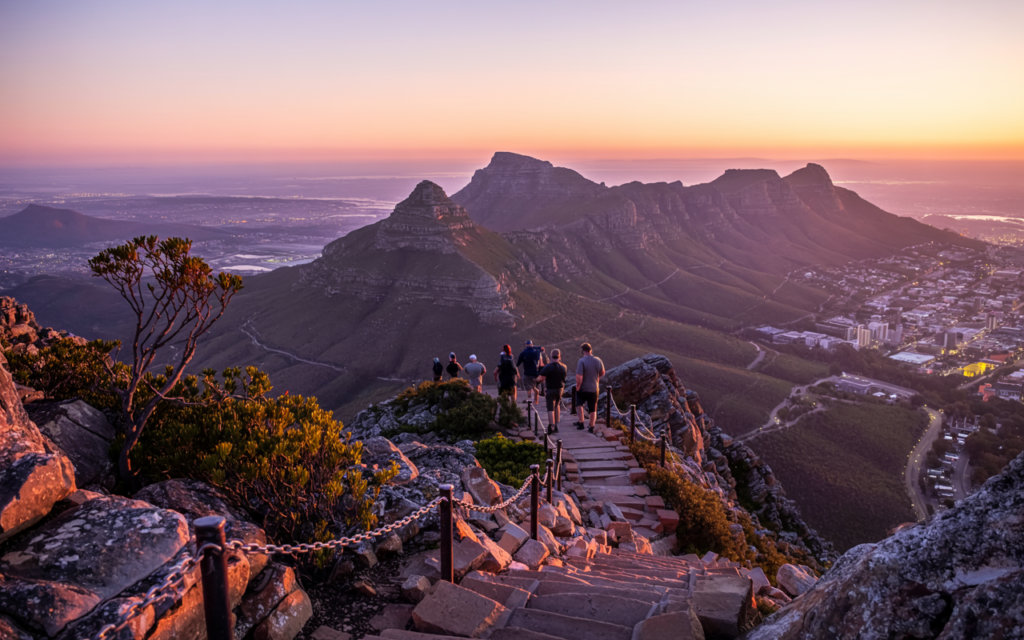
Why it’s one of the best: The perfect ratio of effort to reward. In 90–150 minutes you’ll earn a summit that floats above the city, with Table Mountain’s sheer eastern face to your left, Camps Bay and the Atlantic to your right, and Robben Island out to sea.
It’s the quintessential “first Cape Town hike.”
Quick facts
- Distance: ~5–5.5 km round trip from the main parking (can be shorter depending on start)
- Elevation gain: ~400 m
- Time: 1.5–3 hours round trip (add time for photos/sunset)
- Difficulty: Moderate; short scrambly sections if you take the chains route; a marked “no chains” path bypasses ladders
- Trailhead: Lion’s Head parking area off Signal Hill Road
- Route type: Up-and-back (mostly a spiral path around the peak)
- Best for: Sunrise/sunset, first-time visitors, photogenic city panoramas
Route Description (Step-by-Step)
- Trailhead to Spiral Path: From the parking area, pass the gate and follow the clear, dusty path as it begins its spiral counterclockwise around the mountain. You’ll switch aspects every few minutes—City Bowl views, then Table Mountain’s amphitheater, then Camps Bay and the Atlantic.
- Pine Terrace & View Benches: After 15–20 minutes you reach a broad terrace with pines and benches. It’s a good breather spot and early photo stop; the path narrows beyond.
- Scramble Choice—Chains vs. Walk-Around: Near the upper third you’ll see a signposted split:
- Direct: Chains/Ladders: Short steel ladders, staples, and chains help you scale small rock steps. It’s fun and atmospheric, but can bottleneck at busy times.
- Alternative: Walk-Around: A slightly longer, less exposed footpath that skirts the rocky steps and rejoins above.
- Summit Push: Beyond the merges, the path ramps up over grippy sandstone slabs to the 669 m summit. Expect a little easy scrambling near the top—hands useful, exposure limited. The summit area is small; move with care and give other hikers space.
- Descent: Retrace your steps, typically via the walk-around if the chains are congested. Headlamps are essential if lingering for sunset.
When to Go & Light Angles
- Sunrise: The city and Table Mountain glow pink as the sun breaks behind Devil’s Peak. Best photography toward Table Mountain and over Camps Bay.
- Sunset: Watch the sun drop into the Atlantic; the city lights flicker on below. Start at least 90–120 minutes before sunset to avoid climbing in the dark.
Safety & Etiquette
- Popular does not mean risk-free: watch footing on dusty or damp rock.
- Don’t queue on ladders longer than necessary; keep people moving.
- Pack a layer: wind on the summit can be icy even on warm evenings.
Variations
- Signal Hill to Lion’s Head base as a gentler warm-up.
- Full-moon walks are beloved but expect crowds; bring a proper light, not just a phone torch.
2. Table Mountain via Platteklip Gorge (Direct Ascent)
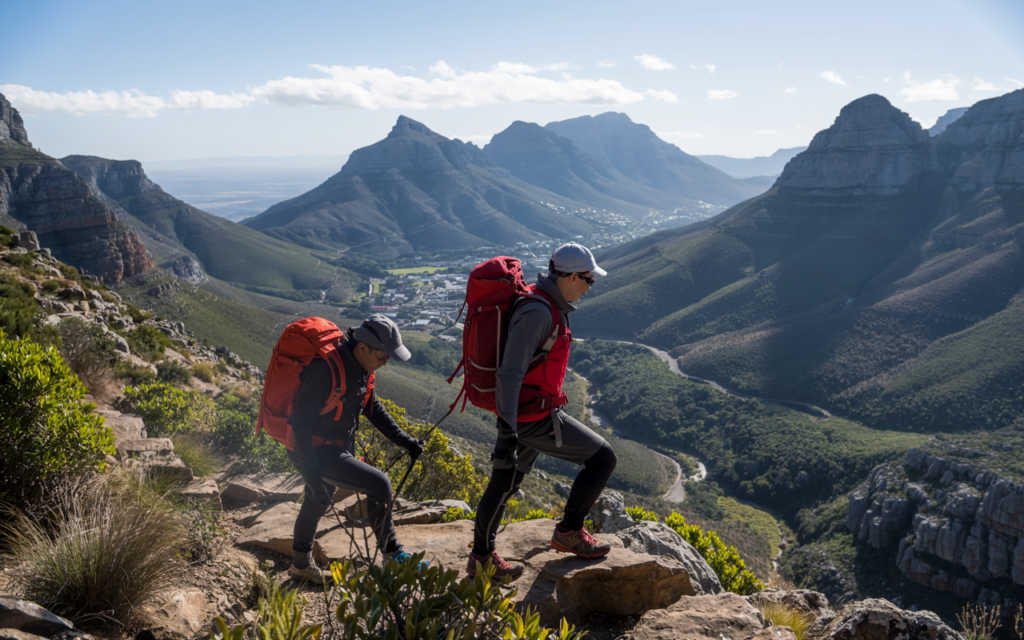
Why it’s one of the best: Platteklip is the fastest, most direct foot route to the top. It’s also the most straightforward to follow: one well-built path in a dramatic cleft up the mountain’s cliffs.
It’s steep and relentless no shade, lots of stone steps—but the sense of arrival at the Table Top is hard to beat.
Quick facts
- Distance: ~5.5–6.5 km round trip (up and down the same way)
- Elevation gain: ~700–750 m
- Time: 2.5–4.5 hours (fit hikers can be faster; add time for descents)
- Difficulty: Moderate-to-hard due to sustained gradient and exposure to sun/wind
- Trailhead: Tafelberg Road (near the base of the Cableway Lower Station area; look for the Platteklip sign)
- Route type: Up-and-back; optional cable car descent in good weather
- Best for: Iconic “I climbed Table Mountain!” bragging rights, tight schedules, hikers who prefer clear wayfinding
Route Description (Step-by-Step)
- Tafelberg Road to Gorge Mouth: From the trail sign, a broad path contours into the lower gorge. Within minutes you’re climbing stone steps beside a seasonal streambed—Table Mountain’s east face looming overhead.
- The Staircase: The heart of Platteklip is a sustained, switchbacking staircase. Take short rests in naturally sheltered corners if the wind is up. Views open to the City Bowl and across to Lion’s Head.
- Upper Gorge & Rock Walls: The walls narrow and steepen; the path remains obvious but footing can be uneven. In summer the heat radiating from rock can be intense—hydrate steadily.
- Top Out at the Table: Emerging from the gorge onto the tabletop is a triumphant moment. You’ll find cairns, boardwalks, and paths marked to the Upper Cable Station (west) and Maclear’s Beacon (east).
- Options on Top:
- Short: Wander viewpoint paths and descend via cable car (check if running).
- Classic return: Retrace your steps down Platteklip (tough on knees).
- Longer traverse: Walk the top to Maclear’s Beacon (highest point) and back before descending or taking the cableway.
Pro Tips
- Start early to beat heat and crowds; in summer, pre-8 a.m. is ideal.
- Poles help on the descent, which is the taxing part for many knees.
- If cloud (the tablecloth) pours over the top, visibility and temperature drop quickly—bring a warm layer and know your line to the cable station or down.
Cableway Logistics
- If you plan to ride down, still be prepared to walk: wind closures happen. Carry water, layers, and headlamp.
- Lines for the cable car can be long; buy a ticket online if you can and pad your time.
3. Skeleton Gorge to Maclear’s Beacon (Forest to the High Point)
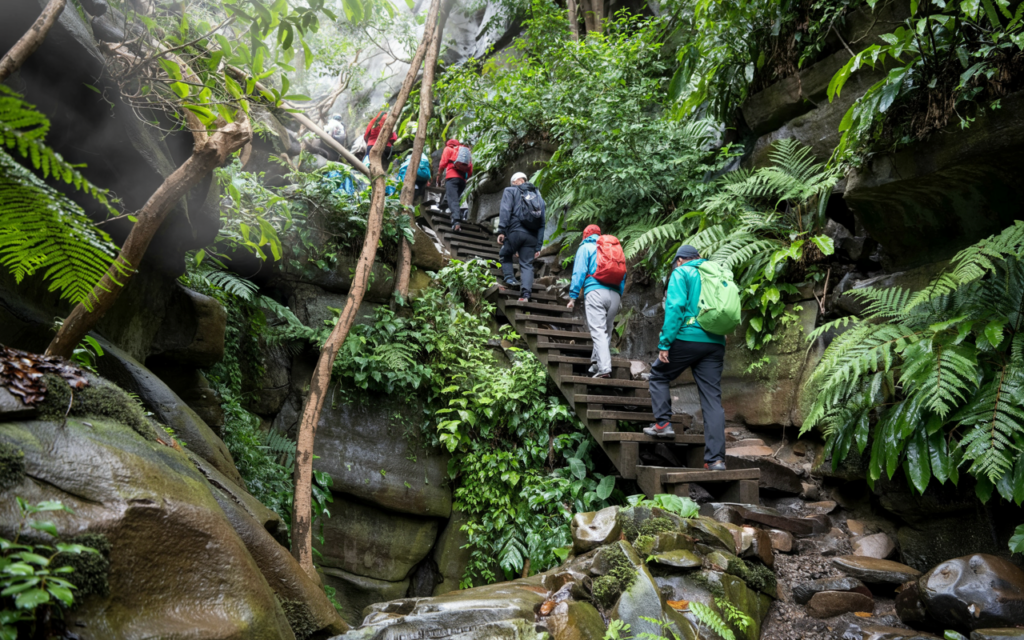
Why it’s one of the best: This route packs three landscapes into one day: the manicured wonder of Kirstenbosch Botanical Garden, a cool Afromontane forest gorge with wooden ladders and boulder hops, and the open fynbos plateau leading to Maclear’s Beacon (1086 m) the highest point on the Table Mountain massif.
It’s the thinking hiker’s route: adventurous but shaded, varied, and richly rewarding.
Quick facts
- Distance: 10–12 km depending on exact lines taken on the top
- Elevation gain: ~900 m from garden to Maclear’s Beacon (including rollers on the plateau)
- Time: 4.5–7 hours (allow a full day with lunch and photos)
- Difficulty: Hard; sustained ascent with ladders and boulder sections; navigation on the top in cloud requires attention
- Trailhead: Inside Kirstenbosch National Botanical Garden (paid entry). Pick up the Skeleton Gorge path from the upper garden.
- Route type: Up-and-back or through-hike (e.g., up Skeleton, across to the Upper Cable Station, down by cable car or via Platteklip/another descent)
- Best for: Shade seekers, botanically curious hikers, and anyone aiming for the massif’s high point
Route Description (Step-by-Step)
- Kirstenbosch to Forest Edge: Enter the gardens early, enjoy quiet paths past proteas and cycads, then follow signs upward toward Skeleton Gorge. The path enters dense, cool forest—bliss on hot days.
- Gorge Ladders & Boulder Hopping: The trail follows a riverbed (often dry in summer), climbing via wooden ladders and stepping stones. It’s not technical, but you’ll use hands frequently. Watch for slippery roots/rocks after rain.
- Smuts Track Junction: Exiting the gorge, you meet the historic Smuts Track, which rolls upward across the tabletop fynbos toward Maclear’s Beacon. The views now spill north and west across the city and Atlantic.
- Maclear’s Beacon: A large cairn and trig beacon mark the 1086 m high point. On a clear day you’ll see Robben Island, the Cape Flats, and the serried blades of the Twelve Apostles marching south.
- Traverse Options:
- To the Upper Cable Station: Continue west along the marked paths (boardwalk sections protect fragile vegetation), eventually reaching the cable car complex and dramatic views into Camps Bay.
- Back to Kirstenbosch: Retrace via Smuts Track and either Skeleton Gorge (steeper downclimb; mind knees and wet boulders) or Nursery Ravine (alternative descent, often preferred in descent).
Pro Tips
- Footwear with grip is essential—wet rock and ladder rungs can be slick.
- Weather hedging: If the top is in cloud but the lower slopes are clear, consider whether you’re comfortable navigating in white-out conditions—paths are good but it’s easy to drift off line.
- Kirstenbosch finish: Reward your legs with a coffee/cake stop in the gardens or at the restaurant—another perk of this route.
Natural Highlights
- Forest flora: Southern Afrotemperate forest species like rooiels and ironwood; mossy, ferny understoreys.
- Fynbos: Look for proteas, ericas, and restios on the plateau (seasonal blooms vary).
4. Kasteelspoort (Twelve Apostles) to the “Diving Board” Ledge
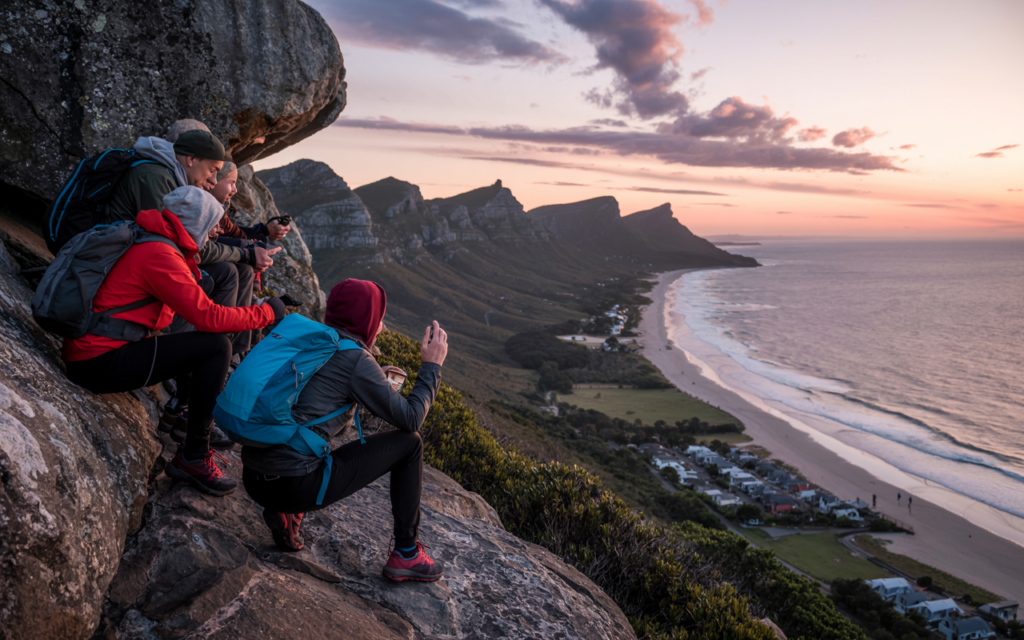
Why it’s one of the best: If Platteklip is the direct line and Skeleton is the shaded one, Kasteelspoort is the scenic west-face journey long views over Camps Bay and the glittering Atlantic, golden sandstone cliffs, and an airy side-trip to the famous “Diving Board” (a natural horizontal rock slab perched above a yawning drop).
The ascent is steady rather than brutal, with classic mountain atmosphere.
Quick facts
- Distance: ~6–9 km depending on detours and return line
- Elevation gain: ~600–700 m
- Time: 3.5–6 hours (longer if lingering at photo spots)
- Difficulty: Moderate-to-hard due to sustained ascent and some rocky steps; less steep than Platteklip, but more “mountain day” than Lion’s Head
- Trailhead: Theresa Avenue/Top of Camps Bay (limited parking) or the Pipe Track approach from Kloof Nek side; pick up the Kasteelspoort path.
- Route type: Up-and-back; or make a loop using the Pipe Track and one of the adjacent ravines (e.g., Corridor, Woody) if competent
- Best for: Big views, photographers, hikers who like a quieter line than Platteklip
Route Description (Step-by-Step)
- Pipe Track Approach: From Camps Bay side, follow the historic Pipe Track (an undulating contour path beneath the Twelve Apostles). It’s a pleasant warm-up with sandstone overhangs and ocean views.
- Kasteelspoort Turn-Up: A clear junction and sign mark the ascent. The trail zigzags up a broad gully between buttresses, with textured rock and hardy fynbos clinging to shelves.
- The “Port” (Saddle) and Top Plateau: After steady switchbacks you crest the Kasteelspoort saddle and arrive on the Table Mountain back-table, a world of boulder fields, dwarf shrubs, and distant sea horizons.
- The “Diving Board” Detour: A short, signposted side path (ask locals or follow GPX tracks) leads to the celebrated Diving Board—a striking slab projecting over void. The photo is iconic, but treat the edge with utmost respect: exposure is real, wind gusts are common, and wet rock is treacherous. Keep a safe margin and never jump or crowd the ledge.
- Return Options:
- Direct back down Kasteelspoort to the Pipe Track and your start.
- Traverse the Apostles Plateau and loop back via the Corridor or Woody Ravine (requires sure-footedness and sound navigation).
- Long day: Continue across the back-table toward the Upper Cable Station and descend by cable car if it’s running.
Pro Tips
- Afternoon light washes the Apostles and Camps Bay in gold—start late morning or early afternoon for a sunset return, but carry headlamps.
- Wind watch: The west face is glorious on calm days but can feel exposed in strong south-easters.
Honorable Mentions (If You Have Extra Days)
- India Venster (to the Cable Station): A superb, exposed scramble line up Table Mountain’s front face with staples/chains. Not for first-timers afraid of heights or in strong wind. Best done with someone experienced or a qualified guide.
- Pipe Track (full traverse): A low-commitment, scenic contour walk beneath the Twelve Apostles—great for rest days or picnics.
- Cape Point (Cape of Good Hope) Trails: Farther from the city but sensational coastal hiking: think cliff-top paths, shipwreck bays, and ostriches strutting on beaches. A day trip here is outstanding when the mountain is socked-in with cloud.
Choosing Your Hike: Quick Decision Guide
- Short & iconic with minimal logistics: Lion’s Head.
- I want to stand on Table Mountain quickly: Platteklip Gorge.
- I love shade/forests and want the true high point: Skeleton Gorge → Maclear’s Beacon.
- I want big sea views and a photogenic ledge: Kasteelspoort → Diving Board.
Fitness & exposure tolerance:
- Least exposure: Platteklip, Skeleton Gorge (though ladders and boulders require balance).
- Some exposure/ladder fun: Lion’s Head (chains route optional).
- Photo ledge with serious drop: Diving Board (Kasteelspoort detour)—caution.
Detailed Planning & Logistics
Getting to Trailheads
- Rideshare (Uber/Bolt): Reliable and often easiest no parking stress.
- Parking:
- Lion’s Head: Along Signal Hill Road; fills at sunrise/sunset. Guard presence varies; remove valuables.
- Platteklip/Cableway Lower Station: Spaces along Tafelberg Road; can be busy.
- Kasteelspoort: Theresa Ave/Camps Bay residential streets have limited parking; be respectful and observe signage.
- Kirstenbosch: Large paid parking areas at the gardens; safest option of the four.
Time of Day & Heat Strategy
- Summer (Nov–Mar): Start before 7 a.m. for Platteklip and Skeleton; consider late-afternoon Lion’s Head/Kasteelspoort with a firm headlamp plan.
- Winter (Jun–Aug): Crisp air and sharp visibility; watch for slippery rock after rain and short daylight hours.
Water & Food
- Bring more than you think: 1.5 L minimum for Lion’s Head; 2 L for Platteklip; 2–3 L for Skeleton and Kasteelspoort on warm days.
- Snacks that handle heat: biltong, nuts, energy bars, fruit, sandwiches.
- There are no shops at trailheads except near the Cableway/Kirstenbosch entrances—stock up in town.
Maps & Navigation
- While these routes are well-traveled, offline maps are smart insurance, especially on the top where paths braid and cloud can drop suddenly. Look for marker cairns and boardwalks protecting sensitive habitat.
Weather & the “Tablecloth”
- That dramatic cloud waterfall over the plateau is beautiful and chilling. If you see the tablecloth forming, expect cooler temperatures, reduced visibility, and often strong winds at the edges. Put on a layer before you get cold; turn around if unsure.
Wildlife & Environmental Care
- Baboons are clever and persistent do not feed or approach. Keep food packed away, even at rest stops.
- Snakes: Puff adders and Cape cobras occur; most incidents happen when people step on them. Watch your step, especially in warm months.
- Flora: Fynbos is fragile. Staying on trail prevents erosion and protects rare species.
Guiding & Group Hikes
If you’re new to scrambling (e.g., Lion’s Head chains) or want to attempt India Venster or an Apostles traverse, consider hiring a qualified local guide.
They’ll also optimize weather windows and logistics.
The Hikes in Depth: Trail-by-Trail Planning
1) Lion’s Head — In Depth
Highlights you’ll remember
- A moving panorama as you spiral around the peak: Table Mountain’s eastern buttresses, the tidy grid of Green Point & Sea Point, the arc of Camps Bay, and the ocean yawning to the horizon.
- The social, friendly vibe on sunrise and full-moon evenings—locals, visitors, photographers, trail runners, and families.
Photographer’s notes
- Sunrise: Blue hour silhouettes of Table Mountain, then warm light on the Apostles.
- Sunset: Best vantage is the west- and south-facing edges for sun-on-sea shots; city lights blossom after dusk—bring a tripod plate if you’re serious.
Crowd hacks
- Go mid-week at first light.
- In peak summer, choose a breezy day (moderate wind can thin crowds but be cautious on exposed ledges).
Common mistakes to avoid
- Underestimating the steepness near the top—allow enough time.
- Attempting the ladders with large packs or without giving space to descending hikers.
- Staying for sunset without a light.
2) Platteklip Gorge — In Depth
Why hikers love it
- It’s as honest as a trail gets: look up, pick your pace, and grind. The gorge walls tower around you; the city falls away beneath your feet. You top out with the whole table at your feet.
Pacing strategy
- Break the climb into 10–15 minute blocks, sipping water each time you pause.
- Keep steps short and rhythmic; the gorge rewards consistency over sprinting.
Descent strategy
- Poles help keep pressure off your knees; many hikers find the descent more tiring than the ascent because of constant down steps.
- If your quads are toast on top, ride the cableway—but only if it’s operating.
Add-on: Maclear’s Beacon out-and-back
- From the gorge top, the rolling tabletop to Maclear’s Beacon is a worthy extension (allow 60–90 minutes return). Boardwalks and paving stones mark the path through sensitive fynbos.
3) Skeleton Gorge → Maclear’s Beacon — In Depth
What makes this route special
- You feel the ecosystem shift under your boots: garden lawns to shaded forest, then boulder-strewn streambeds, then the airy, open tabletop. Few routes anywhere offer such contrast within a few kilometers.
Ladder etiquette
- Only one person per ladder section at a time; maintain spacing on wet days. Pass packs up/down if someone is nervous rather than crowding.
Route-finding on the plateau
- The Smuts Track is well-defined, but in cloud the world shrinks. Keep phone/GPX handy and follow cairns and boardwalks. If the wind howls and you lose the line, pause, reassess, and consider retreat to clearer terrain.
Descent options
- Nursery Ravine is a favored down route—still steep, but with fewer bouldery streambed sections than Skeleton. Back in Kirstenbosch, enjoy a slow botanical wander and a well-earned late lunch.
4) Kasteelspoort → “Diving Board” — In Depth
The mood of the Apostles
- It’s vast, airy, and wild for a city hike. The Twelve Apostles are a procession of buttresses; light rakes across their faces through the afternoon. You’ll see paragliders riding thermals above Camps Bay and—on calm days—mirror-flat ocean surfaces.
On the ledge
- The Diving Board looks made for daring antics, but this is a place for quiet caution. Keep your center of gravity low if you approach it, avoid the very edge, and skip it entirely if the rock is damp or the wind is gusty.
Looping alternatives
- Strong hikers can make a loop by descending Woody Ravine (steep, with rock steps) to the Pipe Track and strolling back to the start. It completes a wonderful half-day circuit with variegated views.
Sample 3-Day Hiking Itinerary (If You Want to Do Them All)
Day 1: Lion’s Head at Sunrise + City Day
Start pre-dawn, summit for sunrise, descend as the city wakes. Brunch on Bree Street, easy sightseeing in the V&A Waterfront, and an early night.
Day 2: Platteklip to the Table Top + Cableway Down
Hit the trail at 7 a.m., top out by mid-morning. Traverse to viewpoints, then descend by cable car if running. Afternoon beach time in Camps Bay.
Day 3: Skeleton Gorge to Maclear’s Beacon (or Kasteelspoort if it’s windy)
If the mountain’s in cloud on the west, choose Skeleton (more sheltered in the gorge). If clear and calm, take Kasteelspoort for sunset light. Celebrate with dinner on Kloof Street.
Responsible Hiking: Leave No Trace on Table Mountain
- Plan ahead & prepare: Know your route, weather, and exit options.
- Travel on durable surfaces: Stick to established paths and boardwalks.
- Dispose of waste properly: Pack out all litter, including fruit peels.
- Leave what you find: Don’t pick flowers; fynbos is fragile and often rare.
- Respect wildlife: Observe, don’t interact—especially with baboons.
- Be considerate: Keep noise down, yield courteously on narrow paths, and don’t drone where prohibited.
Frequently Asked Questions
Can beginners do these hikes?
Yes with Lion’s Head as a great start and Platteklip for determined beginners in good weather.
Skeleton Gorge and Kasteelspoort are better for people with a bit of stamina and comfort with rocky terrain.
Is the cable car reliable for descending?
It’s dependable when operating, but wind closures are common. Always be prepared to hike down.
What about crime on the mountain?
Incidents do occur. Hike in groups, avoid isolated side paths, start early, and keep valuables out of sight. Consider local hiking groups or guides.
Do I need permits?
No permits for these four routes, but Kirstenbosch (Skeleton Gorge start) has paid entry, and the cableway is a separate ticket if you ride it.
Are there toilets on the mountain?
Kirstenbosch and the Cableway stations have facilities; otherwise, none on trail—plan accordingly.
Can I hike with kids?
Older kids/teens with hiking experience often enjoy Lion’s Head (using the ladder bypass) and Platteklip with lots of breaks. Keep safety margins generous.
Packing List (Cape Town Specific)
- Breathable hiking top + shorts/leggings; light mid-layer; wind/rain shell
- Trail shoes/boots with good tread
- Cap/hat, sunglasses, sunscreen (reapply)
- 1.5–3 L water (hydration bladder recommended)
- Snacks/lunch; electrolytes on hot days
- Phone with offline maps + power bank (optional)
- Small first-aid kit; blister care; personal meds
- Headlamp (especially for sunrise/sunset plans)
- Cash/card for Kirstenbosch or Cableway; ID
Final Thoughts
Cape Town rewards hikers who plan thoughtfully, start early, and respect the mountain.
Tackle Lion’s Head for the mood and the city lights, Platteklip to stand proudly on the Table, Skeleton Gorge for a forest-to-fynbos odyssey to the true high point, and Kasteelspoort for the west-face drama and that unforgettable ledge (from a safe stance).
Do all four and you’ll have experienced the full personality of Table Mountain—its social side, its stern test, its shaded secrets, and its ocean-battered grandeur.