
The first time I laced up my sneakers in Barcelona, I had no real plan just a scribbled route in my notebook and a quiet promise to myself: walk slowly, look up often, and let the city reveal itself.
That morning light spilling across stone façades felt like a welcome. Church bells echoed through narrow alleyways. Café chairs scraped softly against cobblestones. The scent of warm bread and espresso drifted through the air.
Barcelona is not a city you rush.
It’s a city you wander.
And if this is your first time here, a self-guided walking tour is the most intimate, flexible, and rewarding way to experience it.
You can pause when something catches your eye, step into a bakery without checking your watch, and sit in a plaza longer than planned.
This ultra-detailed guide will walk you through:
- A carefully structured, easy-to-follow route
- Step-by-step navigation with map points
- Historical context and insider details
- Where to eat authentic food (and where not to)
- How to avoid tourist traps
- Smart budgeting tips
- The best neighborhoods to stay in after a long day
- Extra hidden gems most first-timers miss
You’ll finish this post feeling like you’ve already walked the city.
Let’s begin.
Overview of Your Walking Route
Total Distance: 8–10 km (5–6 miles)
Walking Time (without long stops): 5–6 hours
With sightseeing + meals: Full day (8–10 hours)
Suggested Route Order (Logical Flow)
- Barri Gòtic
- La Rambla
- El Raval
- El Born
- Parc de la Ciutadella
- Passeig de Gràcia
- Sagrada Família
- Optional sunset: Bunkers del Carmel
STOP 1: Barri Gòtic (The Gothic Quarter)
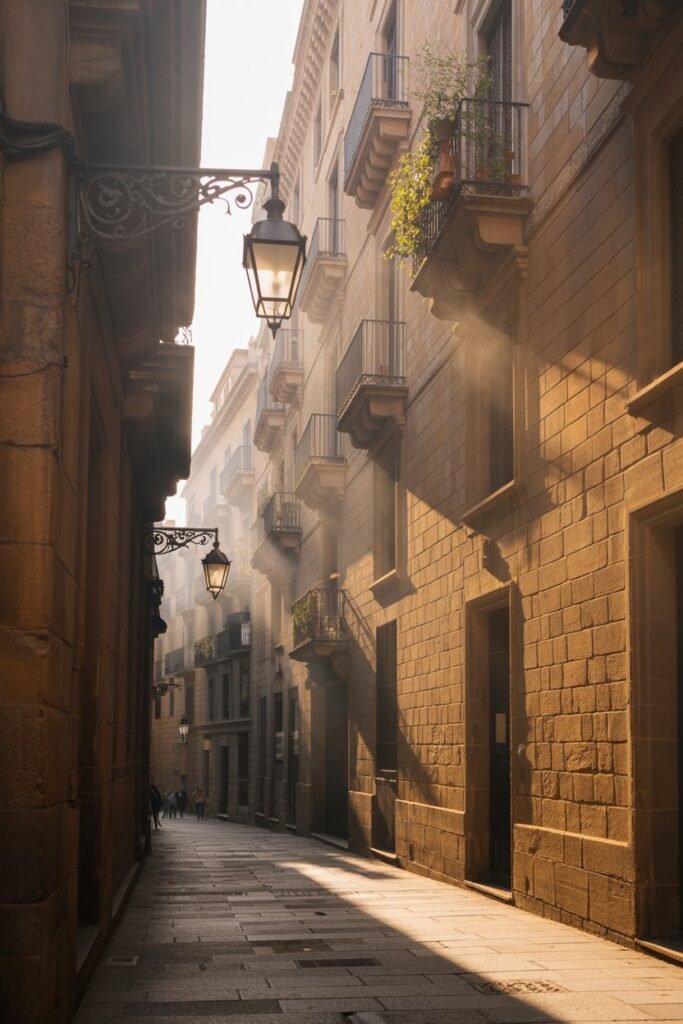
📍 Barri Gòtic
Suggested Time: 2–2.5 hours
Best Time to Start: 8:00–9:00 AM
The first morning I walked into the Gothic Quarter, I didn’t open Google Maps immediately.
I wanted to get slightly lost. And that’s the secret here the Gothic Quarter isn’t meant to be rushed or navigated like a checklist. It’s meant to be absorbed.
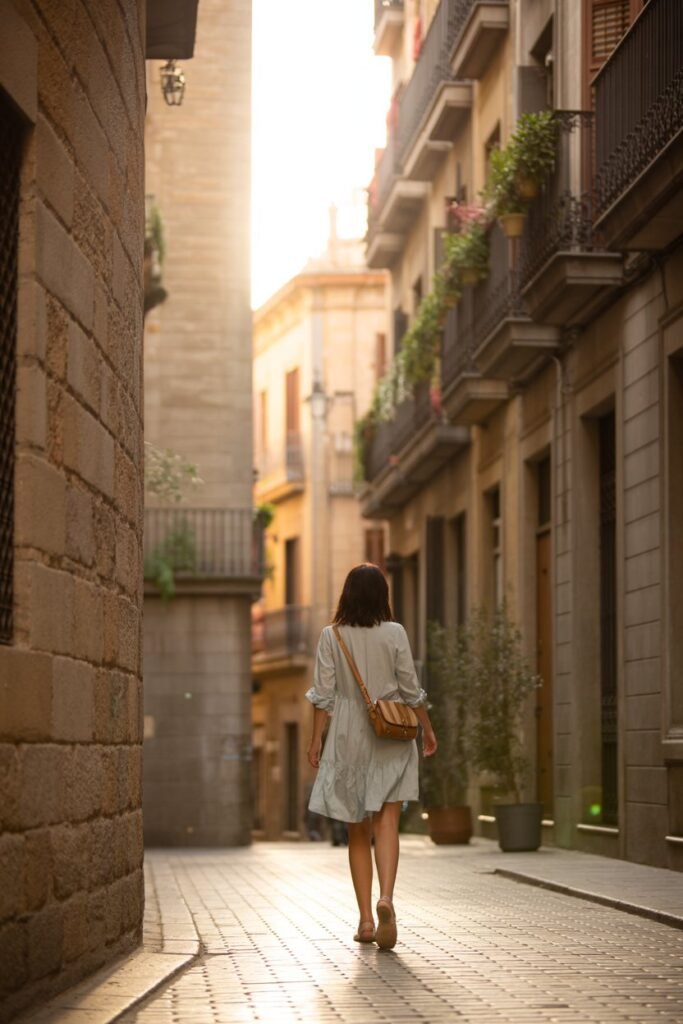
The streets narrow almost immediately. Buildings lean toward each other like they’re whispering secrets from centuries ago. Laundry lines stretch above your head.
Small balconies overflow with plants. The stone beneath your feet is worn smooth by thousands of years of footsteps Roman, medieval, modern.
This is where Barcelona began.
How to Enter the Gothic Quarter (Without the Crowds)
Most first-time visitors enter from La Rambla and get swallowed by tour groups. I recommend starting at the quieter edge near Jaume I metro station. This lets you experience the area before cruise ship crowds arrive.
Pro Strategy:
- Arrive before 9:00 AM.
- Walk slowly.
- Look up often (architectural details are above eye level).
- Avoid checking your phone constantly.
1. Barcelona Cathedral (La Seu)
📍 Barcelona Cathedral
You’ll first notice the spires — dramatic, intricate, almost lace-like against the sky. Although the cathedral was begun in the 13th century, the façade you see today was completed in the 19th century in neo-Gothic style.
What Makes This Cathedral Special
Unlike grand European cathedrals that overwhelm with scale, this one draws you inward. The courtyard cloister is peaceful. You’ll hear water before you see it.
Inside the cloister live 13 white geese, representing Saint Eulalia, co-patron saint of Barcelona, who was martyred at age 13. The symbolism is subtle but deeply meaningful in Catalan culture.
What to See Inside (Don’t Skip These)
- The Choir Stalls – intricately carved wooden seating from the 14th century.
- The Crypt of Saint Eulalia – located beneath the high altar.
- The Rooftop Terrace – take the elevator up for sweeping views over Gothic rooftops.
Visiting Tips
- Entry is free during specific morning hours (check updated schedule before your visit).
- Dress modestly (covered shoulders and knees recommended).
- Spend at least 45–60 minutes here.
Plaça del Rei — Medieval Drama
📍 Plaça del Rei
Step into this square and everything quiets.
Tall stone walls surround you. The Royal Palace complex rises with austere elegance. This square was once the political heart of medieval Barcelona.
Legend says Christopher Columbus was received here by Queen Isabella and King Ferdinand after returning from the Americas.
Whether historically precise or not, the atmosphere feels regal.
Photography Tip:
Visit before 10:30 AM for soft lighting and fewer people.
Hidden Corners You Shouldn’t Miss
1. Carrer del Bisbe
This street features the famous neo-Gothic bridge connecting government buildings. It’s one of the most photographed spots in the Gothic Quarter but most people don’t look up long enough to see the intricate carvings.
2. Jewish Quarter (El Call)
Quiet, narrow, and deeply historical. This area once housed Barcelona’s medieval Jewish community. The silence here feels different reflective, almost sacred.
3. Plaça Sant Felip Neri
One of the most hauntingly beautiful squares in the city. The church façade still bears scars from bombing during the Spanish Civil War. It’s peaceful now, but emotionally powerful.
Where to Eat Breakfast in the Gothic Quarter
Skip anywhere with laminated menus in five languages.
Instead, look for:
- Small cafés with 5–6 tables.
- Locals standing at the bar drinking espresso.
- No aggressive hosts outside.
Order:
- Café con leche
- Pan con tomate (bread rubbed with tomato, olive oil, salt)
- A fresh croissant or ensaimada
Budget: €5–8
Tourist Trap Warnings (Gothic Quarter)
- Avoid restaurants directly in front of major landmarks.
- Ignore people offering “fast track” tickets.
- Don’t exchange currency here (rates are terrible).
- Watch for pickpockets in crowded alleys.
Use a crossbody anti-theft bag.
STOP 2: La Rambla — Navigate It Smartly
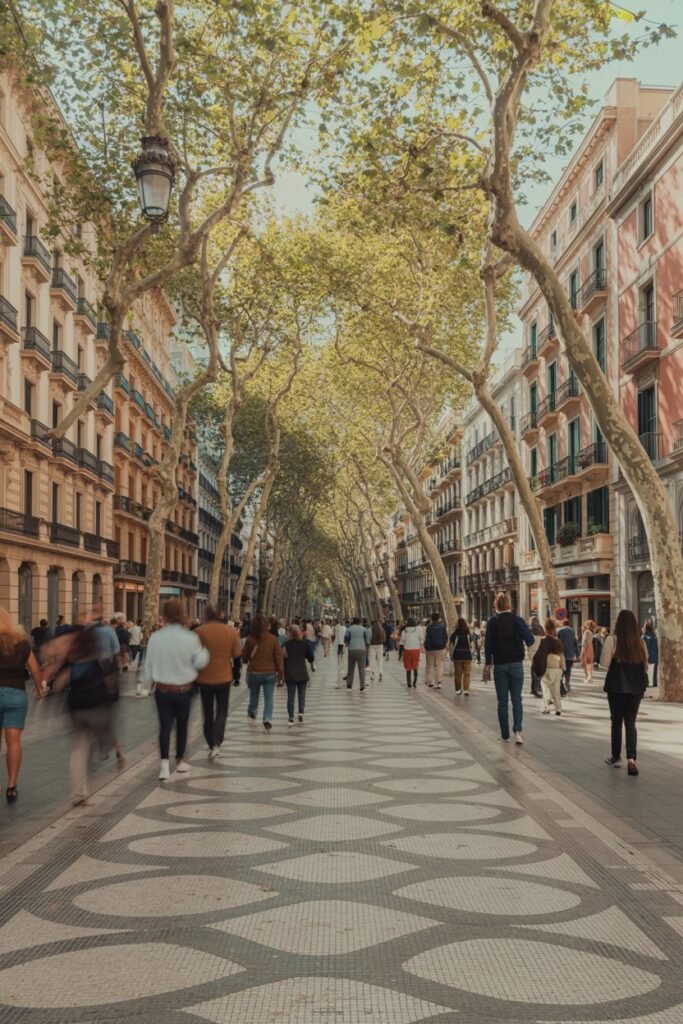
📍 La Rambla
Suggested Time: 45–60 minutes max
La Rambla is iconic but also the most tourist-saturated street in Barcelona.
It stretches 1.2 km from Plaça de Catalunya to the waterfront. It’s lively, chaotic, colorful and yes, a bit overwhelming.
The key is to experience it without letting it consume your time or budget.
What You’ll See
- Flower stalls
- Street performers
- Newspaper kiosks
- Historic cafés
- Mosaic by Joan Miró embedded in the pavement
Pause briefly at the Miró mosaic most people walk right over it.
Mercado de La Boquería
📍 Mercado de La Boquería
This market is visually stunning. Fruit displays look like art installations.
But here’s the honest truth: it’s very tourist-heavy now.
How to Experience It Without Overpaying
- Walk past the first few fruit stalls.
- Compare prices before buying.
- Avoid takeaway fruit cups priced above €4.
- Look for small tapas counters deeper inside.
If you want something authentic:
- Try grilled seafood from interior stalls.
- Order freshly squeezed juice (but check price first).
The Liceu Opera House
📍 Gran Teatre del Liceu
Founded in 1847, this opera house has survived fires and civil unrest. If you love architecture, check if short guided tours are available.
Should You Eat on La Rambla?
Short answer: No.
Long answer: Walk one or two streets away and prices drop dramatically.
Safety on La Rambla
This is the most common place for pickpocketing.
Protect yourself by:
- Wearing bags in front.
- Not keeping phones in back pockets.
- Ignoring distraction tactics (like someone “spilling” something on you).
STOP 3: El Raval — Edgy, Creative, Unexpected
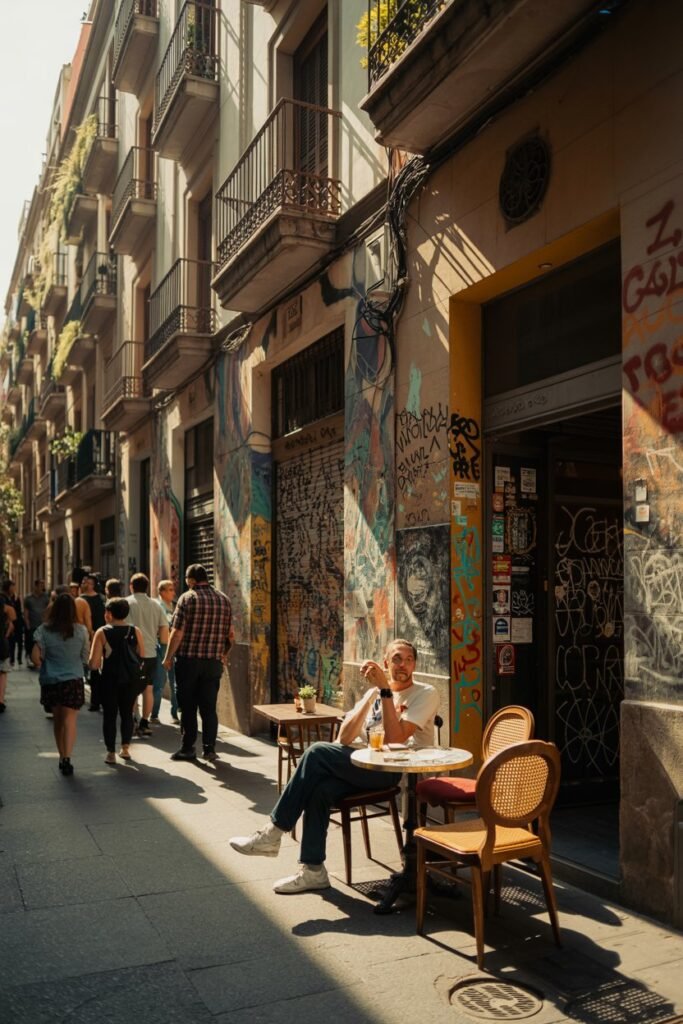
📍 El Raval
Suggested Time: 1–1.5 hours
Cross La Rambla and everything changes.
El Raval feels raw and artistic. It’s multicultural and slightly chaotic in places but full of personality.
This is where Barcelona shows a different side.
MACBA — Barcelona Museum of Contemporary Art
📍 Barcelona Museum of Contemporary Art
Even if you don’t enter, the square outside is iconic. Skateboarders glide across the white stone plaza. It’s energetic and modern.
If you enjoy contemporary art, allow 1–1.5 hours inside.
Street Art & Local Culture
El Raval is known for:
- Independent bookstores
- Vintage shops
- Street art murals
- Multicultural restaurants
This area reflects immigration waves that shaped modern Barcelona.
Where to Eat in El Raval
This is where you’ll find some of the city’s best international food.
Look for:
- Pakistani bakeries
- Middle Eastern falafel spots
- Trendy vegan cafés
- Authentic Catalan tapas bars tucked into side streets
Avoid:
- Restaurants with giant “PAELLA €9.99” signs.
- Places with laminated photos of dishes.
Is El Raval Safe?
During the day: Yes, generally safe.
At night:
- Stick to well-lit streets.
- Avoid wandering aimlessly after midnight.
- Stay aware of surroundings.
How These Three Stops Flow Together
The Gothic Quarter grounds you in history.
La Rambla introduces movement and spectacle.
El Raval contrasts tradition with modern grit.
Together, they create emotional balance old, iconic, raw.
STOP 4: El Born — Where Medieval Barcelona Meets Creative Energy
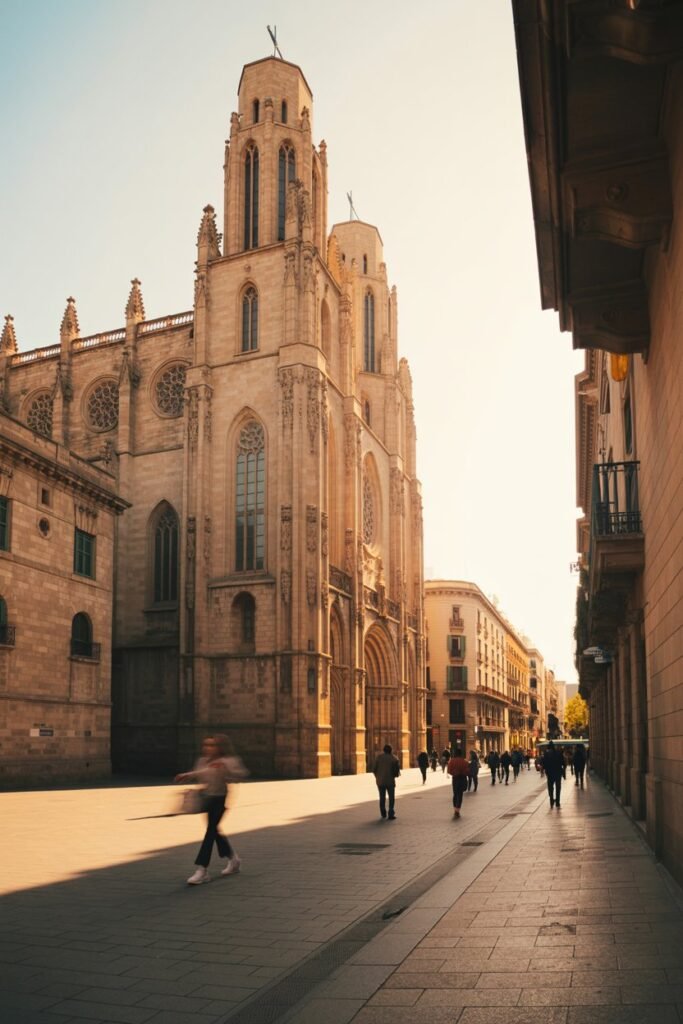
📍 El Born
Suggested Time: 2–3 hours
Best Time to Arrive: Late morning (11:00 AM – 12:00 PM)
Crossing from the Gothic Quarter into El Born feels subtle at first. The streets remain narrow. The stone remains golden. But something shifts. The mood softens. Cafés spill onto sidewalks. Boutique shops replace souvenir stalls. Locals linger over vermouth.
If the Gothic Quarter feels like a history book, El Born feels like a living chapter.
This is where I always slow down.
Understanding El Born’s Identity
El Born was once a prosperous medieval trading district. Merchants, artisans, and shipbuilders shaped its growth. Today, it blends history with independent fashion, wine bars, and creative studios.
You’ll notice:
- Fewer tour groups.
- More locals.
- More stylish cafés.
- A calmer energy.
And yet, it remains deeply historic.
Santa Maria del Mar — The Cathedral of the Sea
📍 Santa Maria del Mar
If you only enter one Gothic church in Barcelona, make it this one.
Unlike the ornate drama of the Cathedral, Santa Maria del Mar feels pure and balanced. It was built in the 14th century by the neighborhood’s shipbuilders in just 55 years, remarkably fast for that era.
What Makes It Unique
- Wide interior supported by slender octagonal columns.
- Minimal ornamentation.
- Beautiful symmetry.
- Soft light filtering through stained glass.
Stand quietly in the center aisle and look upward. The ceiling feels impossibly high and airy.
Rooftop Tour (Highly Recommended)
For a small additional fee, you can access the rooftop terraces.
From here you’ll see:
- Medieval rooftops of El Born.
- Views toward the Mediterranean.
- A perspective of Barcelona few tourists take.
Time Allocation: 45–60 minutes minimum.
El Born Cultural Centre
📍 El Born Centre de Cultura i Memòria
This former market hall houses archaeological ruins from 18th-century Barcelona preserved beneath a dramatic iron structure.
It tells the story of 1714, when Barcelona fell during the War of Spanish Succession a defining moment in Catalan identity.
Even if you don’t go inside, step in briefly to see the ruins from above. It adds historical context to the streets you’re walking.
Passeig del Born — Pause Here
This wide promenade is perfect for:
- Midday vermouth.
- Espresso break.
- Light tapas.
Sit outside and order:
- Patatas bravas
- Croquetas
- A small glass of cava
This is where Barcelona feels unhurried.
Hidden Gems in El Born
1. Carrer de Montcada
A street lined with medieval palaces. Several now house museums, including:
📍 Picasso Museum
Even if you skip the museum interior, the architecture alone is worth seeing.
2. Tiny Artisan Boutiques
Look for:
- Handmade leather shops.
- Independent jewelry designers.
- Locally crafted ceramics.
Avoid:
- Stores selling mass-produced flamenco souvenirs.
- “3 T-shirts for €10” stalls.
Where to Eat in El Born (Authentic Choices)
Best For Lunch:
- Small tapas bars on side streets.
- Places with handwritten chalk menus.
- Restaurants offering “Menú del Día” (3-course lunch set).
Typical cost:
€15–25 for full lunch with drink.
What to Order:
- Grilled octopus (pulpo a la gallega)
- Jamón ibérico
- Catalan-style sausage (butifarra)
- Pa amb tomàquet
Avoid restaurants with staff waving you in aggressively.
Transition to Stop 5
From Santa Maria del Mar, walk northeast for about 8–10 minutes toward greenery. You’ll feel the city opening up.
Stone streets give way to trees.
You’ve reached your restorative pause.
STOP 5: Parc de la Ciutadella — Barcelona’s Green Escape
📍 Parc de la Ciutadella
Suggested Time: 1–1.5 hours
Ideal Arrival: Early afternoon
After hours on stone streets, your feet will thank you for this stop.
Parc de la Ciutadella is Barcelona’s most beloved park. Locals jog here. Students read in the grass. Musicians practice under trees.
It feels like an exhale.
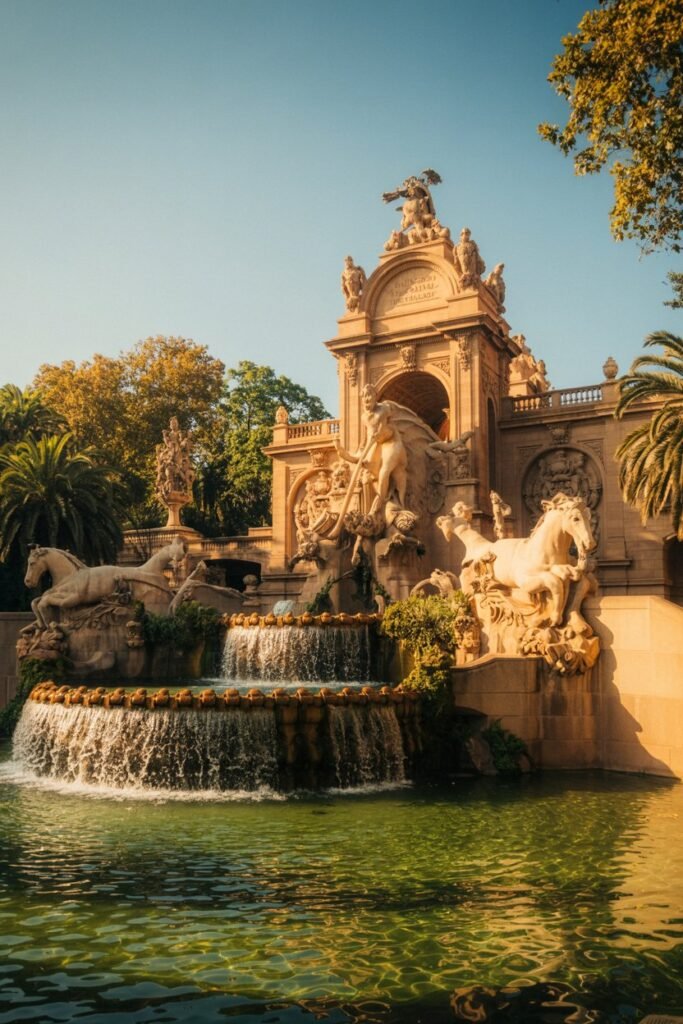
The Cascada Monumental — Don’t Miss This
The park’s crown jewel is its dramatic fountain.
Fun fact: A young Antoni Gaudí contributed to its design early in his career.
The fountain is ornate golden statue at the top, cascading water below, flanked by mythological sculptures.
Sit on a bench facing it. Rest. Hydrate.
Lake & Rowboats
For a few euros, you can rent a small rowboat and paddle across the lake.
It’s romantic. It’s peaceful. It’s a perfect mid-walk reset.
Picnic Strategy
This is the best place on your route to enjoy a light picnic.
Buy earlier:
- Fresh bread
- Cheese
- Fruit
- Jamón
Sit under the trees and recharge.
The Arc de Triomf (Optional Nearby Stop)
Just outside the park stands:
📍 Arc de Triomf
Built for the 1888 World Fair, this red-brick arch is different from Paris’ version — lighter, more decorative.
The palm-lined promenade leading to it is perfect for photos.
Safety & Comfort Tips
- Watch your belongings even in parks.
- Refill water bottles at fountains.
- Apply sunscreen Barcelona sun is stronger than it feels.
Transition to Stop 6
From the park, you’ll likely take:
- A 20-minute walk
OR - A short metro ride to Passeig de Gràcia.
This shift marks the beginning of Barcelona’s most visually surreal chapter.
STOP 6: Passeig de Gràcia — Gaudí’s Architectural Wonderland
📍 Passeig de Gràcia
Suggested Time: 2–3 hours
Best Time: Late afternoon
Passeig de Gràcia is wide, elegant, and lined with luxury boutiques.
But the true stars here are the Modernist buildings.
This is where Barcelona begins to look like a dream.
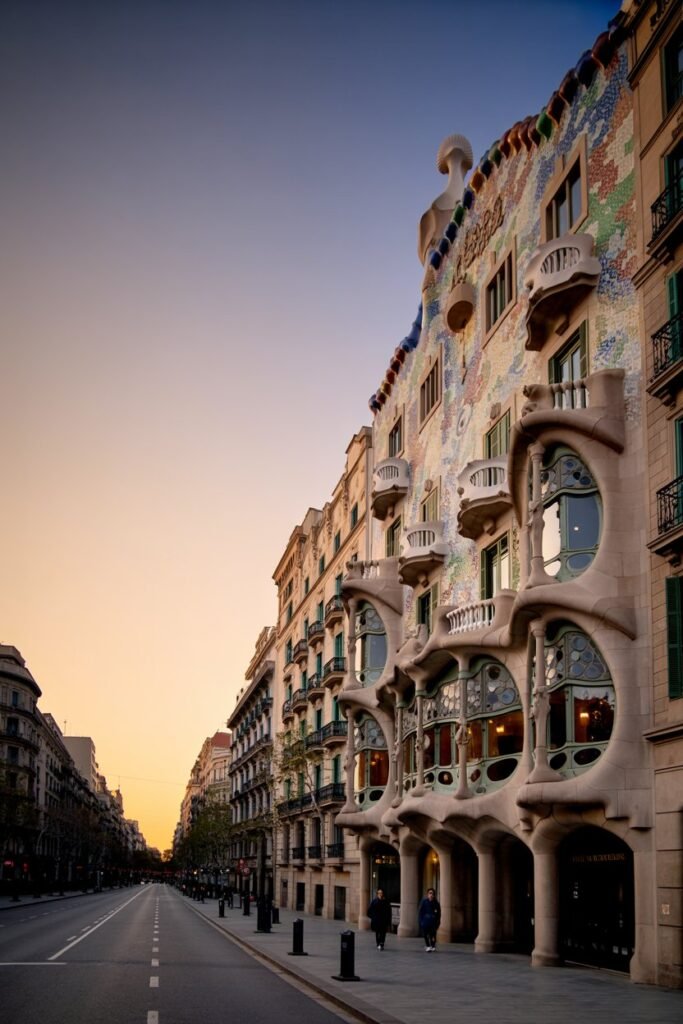
Casa Batlló — The Most Fantastical House in the City
📍 Casa Batlló
Built by Antoni Gaudí between 1904–1906.
From the outside, it resembles:
- A dragon’s back (roof tiles)
- Bone-like balconies
- Undulating ocean waves
No straight lines.
Everything curves.
Inside Experience
The interior is immersive and otherworldly:
- Light wells tiled in gradient blues.
- Flowing wooden staircases.
- Marine-inspired shapes.
Allow 1–1.5 hours inside.
Buy tickets online. Prices range €29–35+.
Casa Milà (La Pedrera)
📍 Casa Milà
Built slightly later, Casa Milà is more subdued outside but its rooftop is surreal.
The rooftop chimneys look like silent stone guardians.
If choosing one:
- Casa Batlló = more colorful.
- Casa Milà = more structural and sculptural.
Sidewalk Details You Might Miss
Look down occasionally.
Passeig de Gràcia’s pavement features distinctive hexagonal tiles designed by Gaudí.
They depict marine motifs like sea stars.
Even the ground is art.
Where to Eat Near Passeig de Gràcia
Avoid luxury chain restaurants directly on the avenue.
Instead:
- Walk 1–2 blocks inward.
- Look for Catalan bistros.
- Try tapas bars filled with locals after work.
Dinner here can cost:
€20–35 per person depending on restaurant.
Budget Advice for Stop 6
If you’re visiting:
- Casa Batlló (€30+)
- Casa Milà (€28+)
Budget €60–70 for architecture alone.
If skipping interiors:
Admire façades for free.
Emotional Shift of Stops 4–6
El Born = medieval charm + creative culture.
Ciutadella = green reset + reflection.
Passeig de Gràcia = artistic fantasy + architectural brilliance.
You’ve now walked through:
- 14th-century Gothic faith.
- 18th-century political memory.
- 19th-century civic expansion.
- Early 20th-century Modernism.
Barcelona is unfolding chronologically as you walk.
STOP 7: Sagrada Família — Barcelona’s Spiritual Crown
📍 Sagrada Família
Suggested Time: 2–3 hours
Best Time to Visit: 9:00 AM or 4:30 PM (for best light)
Tickets: Book at least 1–2 weeks in advance
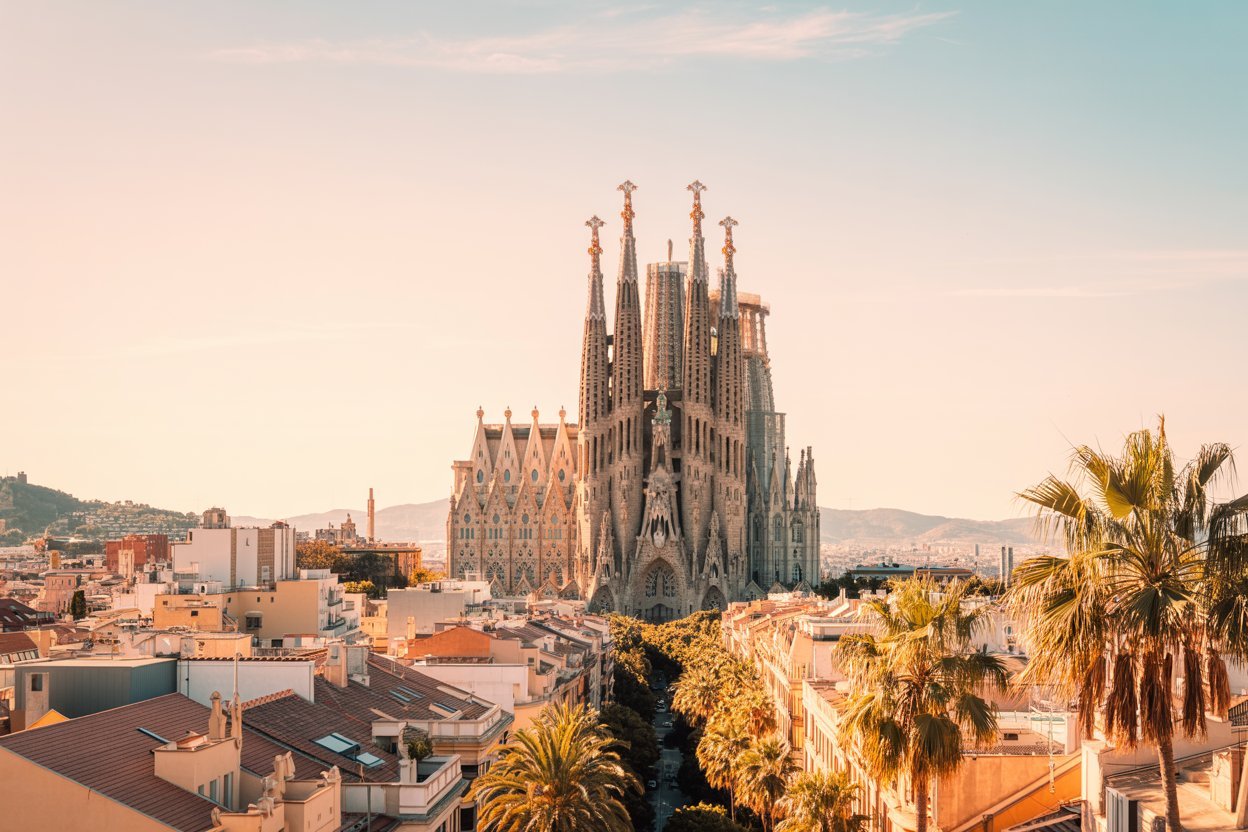
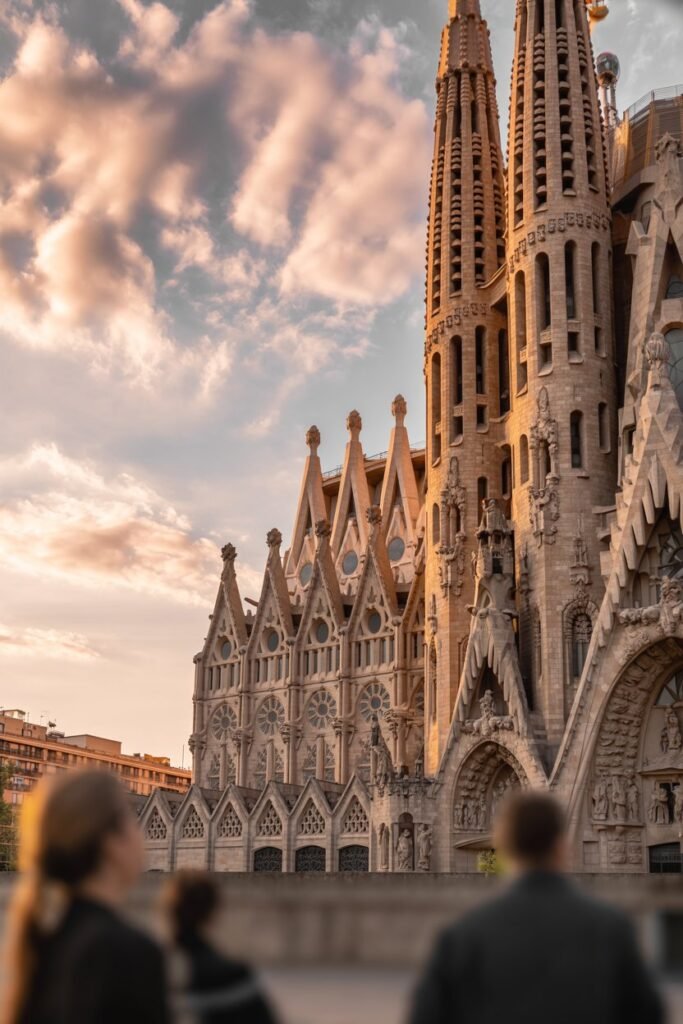
The first time I turned the corner and saw the Sagrada Família, I stopped walking without realizing it. You expect something impressive. What you don’t expect is how emotional it feels.
It rises like something alive not constructed, but grown.
No cathedral in Europe feels like this one.
Understanding What You’re Looking At
Designed by Antoni Gaudí in 1883, the Sagrada Família is still under construction. Completion is projected within the coming years, though delays have shaped its timeline.
Unlike traditional Gothic cathedrals built over centuries with rigid structure, Gaudí reimagined everything:
- Columns inspired by tree trunks
- Light designed to mimic a forest canopy
- Mathematical geometry woven into spiritual symbolism
This is architecture as theology.
The Three Façades (Do Not Skip Walking Around the Entire Exterior)
1. Nativity Façade (East Side)
This is the most detailed and intricate façade. It was completed during Gaudí’s lifetime.
It’s alive with:
- Animals
- Biblical figures
- Natural motifs
- Overwhelming sculptural detail
Visit in the morning when the rising sun illuminates the carvings.
2. Passion Façade (West Side)
Sharp. Angular. Stark.
Unlike the Nativity façade, this one is minimal and dramatic, depicting the suffering of Christ.
The contrast between façades shows Gaudí’s emotional range.
Visit in late afternoon for dramatic shadows.
3. Glory Façade (Still Under Construction)
This will eventually be the largest entrance.
Entering the Basilica — What to Expect Inside
When you step inside, you may instinctively look up.
The columns branch like trees. Light pours through stained glass in gradients — blues and greens on one side, oranges and reds on the other.
As the sun moves, the interior transforms.
The best experience happens between 4:00–6:00 PM when the western sun floods the red and amber glass.
Towers — Should You Go Up?
If available when booking, you can add tower access.
You’ll:
- Take an elevator up
- Walk narrow spiral staircases down
- See elevated views of Barcelona
It’s not ideal if you’re claustrophobic.
How to Avoid Tourist Chaos Here
- Never buy tickets from people outside.
- Arrive 15 minutes early for your slot.
- Download the official audio guide.
- Walk around the entire exterior before entering.
Budget Planning
General admission: €26–40 depending on options.
With tower access: higher.
This is worth budgeting for.
Where to Eat Near Sagrada Família (Smartly)
Avoid restaurants directly facing the basilica — most are overpriced and mediocre.
Instead:
- Walk 2–3 blocks outward into Eixample.
- Look for small Catalan eateries.
- Check for “Menú del Día” boards.
Expect:
€18–30 for quality dinner.
Transition to Stop 8
After absorbing Gaudí’s masterpiece, you’ll head toward a quieter, more local neighborhood.
Take a slow 20–25 minute walk northwest.
You’re entering a different Barcelona now.
STOP 8: Gràcia — The Village Within the City
📍 Gràcia
Suggested Time: 1.5–2.5 hours
Best Time: Evening
Gràcia doesn’t feel like central Barcelona.
It feels like a small town that somehow became part of a major city.
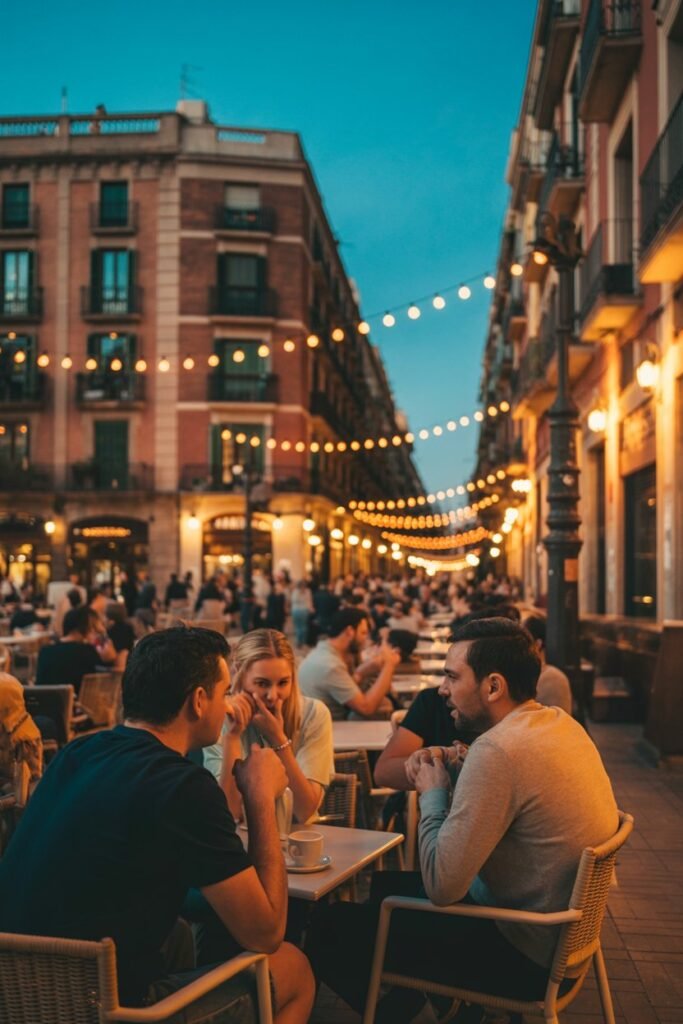
Once an independent village, Gràcia retains its own identity local plazas, families chatting late into the night, children playing freely in squares.
This is where Barcelona breathes.
Plaça del Sol — Start Here
A lively square surrounded by cafés.
Order:
- Vermouth
- Small tapas plate
- Sparkling water
Sit outside. Observe.
No rush.
Why Gràcia Matters
This neighborhood reflects:
- Strong Catalan identity
- Independent businesses
- Anti-commercial culture
- Artistic community
You won’t see luxury boutiques here.
You’ll see:
- Handmade craft shops
- Independent bookstores
- Vintage clothing stores
Authentic Dinner Strategy in Gràcia
Avoid places with:
- English-only menus.
- “Best Paella in Barcelona!” signs.
Look for:
- Catalan grandmothers dining inside.
- Chalkboard menus.
- Limited daily dishes.
Try:
- Escalivada (grilled vegetables)
- Botifarra sausage
- Crema Catalana for dessert
Dinner cost: €20–35 depending on restaurant.
Night Atmosphere
Gràcia becomes magical at night.
Soft lighting. Conversations spilling from cafés. Music drifting from open windows.
This is the Barcelona many tourists never see.
Safety & Comfort
Very safe area. Still stay aware.
Watch your belongings in busy squares.
Transition to Final Stop
If you still have energy and sunset timing aligns your final stop awaits.
This one requires a short bus or taxi ride unless you’re up for a steep uphill walk.
STOP 9: Bunkers del Carmel — Barcelona From Above
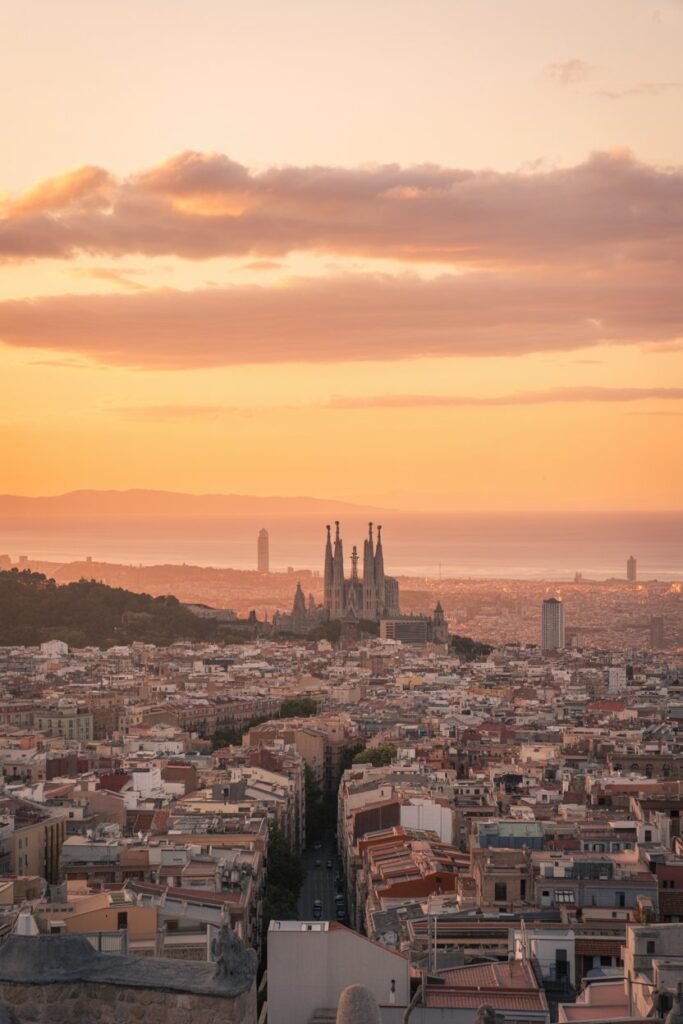
📍 Bunkers del Carmel
Suggested Time: 1–1.5 hours
Best Time: 30–45 minutes before sunset
The Bunkers del Carmel sit high above the city on Turó de la Rovira hill.
Originally anti-aircraft bunkers during the Spanish Civil War, this site now offers the most breathtaking panoramic view in Barcelona.
Getting There
Options:
- Bus from Gràcia.
- Taxi (faster and easier).
- Steep uphill walk (challenging after full day).
Wear stable shoes.
What You’ll See
360-degree views of:
- Sagrada Família rising above rooftops
- Mediterranean coastline
- Grid pattern of Eixample
- Distant mountains
As the sun lowers, the city glows golden.
It’s the perfect emotional closing.
Sunset Strategy
Arrive early to claim a good sitting spot.
Bring:
- Water
- Light jacket
- Small snack
Do not bring glass bottles (often restricted).
Safety Notes
It’s generally safe, but:
- Keep valuables secure.
- Avoid staying too late alone.
- Leave shortly after full darkness if solo.
Reflecting on the Entire Walk
By the time you sit at the Bunkers, you’ve walked through:
- Roman foundations
- Medieval faith
- Catalan resilience
- Modernist imagination
- Local village life
- Panoramic cityscape
You haven’t just seen Barcelona.
You’ve traced its evolution on foot.
How to Avoid Tourist Traps in Barcelona
Barcelona is beautiful and highly touristed.
Here’s how to navigate wisely:
1. Avoid Eating Directly on La Rambla
Side streets = better quality + lower prices.
2. Don’t Buy Tickets From Street Vendors
Always use official websites.
3. Skip Restaurants With Picture Menus
Authentic places rarely display giant food photos.
4. Check Google Reviews Carefully
Look for recent local-language reviews.
5. Visit Major Attractions Early
Before 9:30 AM or after 5 PM.
Where to Stay After Your Walking Tour
1. Gothic Quarter
Atmospheric but can be noisy at night.
2. Eixample
Wider streets, easier navigation, close to Sagrada Família.
3. Gràcia
Local vibe, quieter evenings, charming plazas.
Choose based on your style:
- Central convenience → Eixample
- Historic romance → Gothic Quarter
- Relaxed charm → Gràcia
Budget Breakdown for the Day
| Item | Approximate Cost |
|---|---|
| Coffee & pastry | €5–7 |
| Lunch | €18–25 |
| Casa Batlló | €29–35 |
| Sagrada Família | €26–40 |
| Metro (if needed) | €2.40 per ride |
Total range: €60–120+
Essential Walking Tips
- Wear broken-in sneakers.
- Carry a refillable water bottle.
- Use an anti-theft crossbody bag.
- Download offline maps.
- Bring sunscreen (even in spring).
Final Thoughts
Barcelona reveals itself slowly. Its layers Roman ruins, Gothic spires, modernist dreams, Mediterranean breezes blend into something unforgettable.
Walking it is an act of discovery.
Every corner tells a story. Every plaza invites you to pause.
If you follow this self-guided route, you won’t just check off landmarks you’ll understand the rhythm of the city.
And that’s what makes a first visit unforgettable.