
I still remember standing somewhere far from home, watching the sky change colors in a way I didn’t know was possible. It wasn’t just a sunset.
It felt like the world was quietly reminding me how small I was and somehow, how lucky I was to witness it.
Travel has a way of doing that.
It humbles you. It stretches your imagination. It reshapes what you thought “beautiful” meant.
Before I started exploring more intentionally, I thought beauty was just beaches and blue water.
But over time, I realized beauty can look like towering cliffs rising from the ocean, ancient temples wrapped in jungle mist, cities glowing under northern lights, or mountains so dramatic they almost look painted into the sky.
This list isn’t just about pretty places.
It’s about destinations that stay with you.
Places that feel surreal in person.
Places that make you pause.
Places that remind you why you started dreaming about travel in the first place.
In this guide, I’m sharing 15 of the most beautiful places in the world carefully chosen for their landscapes, atmosphere, uniqueness, and unforgettable experiences.
And because I want this to truly help you plan your dream trip, I’m also including:
- How to locate each place
- How to get there
- What to do once you arrive
- Safety tips
- How to avoid tourist traps
- What to buy as meaningful souvenirs
- Smart travel tips you’ll be glad you knew beforehand
Let’s begin somewhere dramatic, powerful, and almost otherworldly.
Now lets dive into this 15 Of The Most Beautiful Places In The World To Visit, but befor that lets see some intresting facts.
Interesting Facts About The Most Beautiful Places In The World
Before we dive in, here are a few fascinating facts that might surprise you:
- Some of the world’s most beautiful places are also some of the most remote which is exactly why they’ve stayed pristine.
- Many iconic landscapes were shaped by ancient volcanic activity thousands (or even millions) of years ago.
- Certain destinations look completely different depending on the season meaning timing can transform your experience.
- UNESCO World Heritage sites make up a large portion of the world’s most breathtaking locations.
- The most photographed places aren’t always the most rewarding sometimes the real magic is just beyond the main viewpoint.
And now, let’s begin with a place that looks like it belongs in a fantasy movie.
shoop my amazon essentials
- Universal Travel Adapter
- Packing Cubes
- Anti-Theft Travel Backpack
- Portable Power Bank
- Noise-Canceling Headphones
- Compact Travel First Aid Kit
1. The Dramatic Cliffs of Cinque Terre, Italy
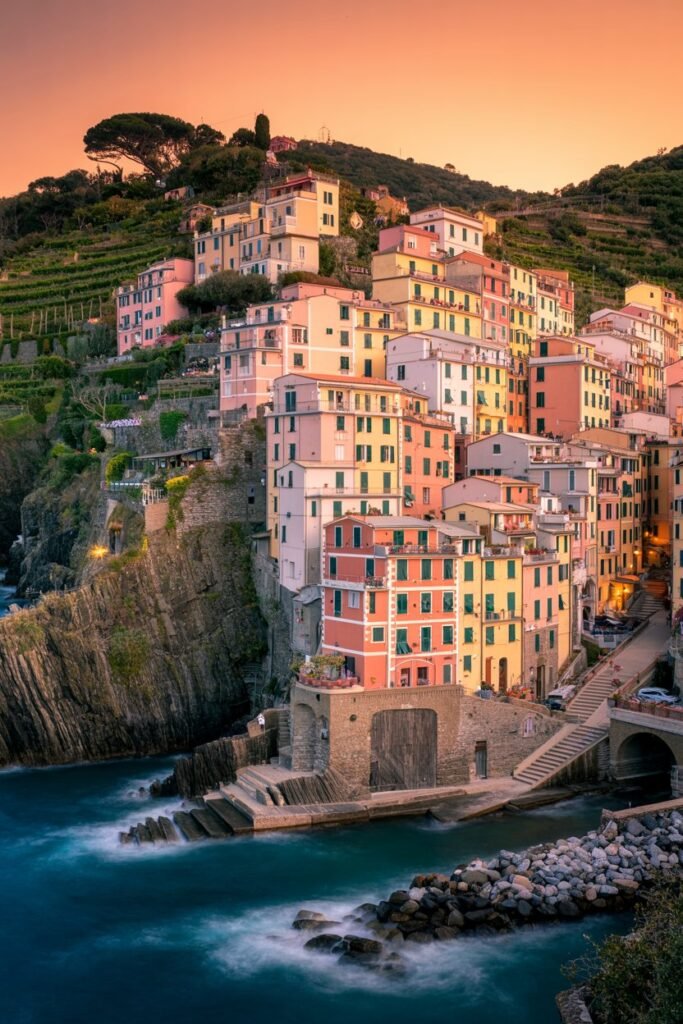
If there’s one place that made me question whether I was still on Earth, it’s Cinque Terre.
Imagine pastel-colored houses stacked dramatically against rugged cliffs. Imagine the Mediterranean sparkling below you.
Imagine narrow pathways winding between villages where laundry hangs from windows and fishing boats rest in quiet harbors.
It feels intimate. It feels cinematic. It feels like Italy in its purest, most romantic form without being overly polished.
Where Exactly Is Cinque Terre?
Cinque Terre is located in the Liguria region of northwestern Italy, along the Italian Riviera. It consists of five small seaside villages:
- Monterosso al Mare
- Vernazza
- Corniglia
- Manarola
- Riomaggiore
The closest major city is Florence (about 2.5 hours by train) and Pisa (about 1.5 hours by train).
How to Get There
The easiest way to reach Cinque Terre is by train.
- Fly into Florence, Pisa, or Milan.
- Take a regional train to La Spezia.
- From La Spezia, hop on the local Cinque Terre train that connects all five villages.
Driving is not recommended. Parking is limited, roads are narrow, and trains are far more convenient.
Why Cinque Terre Is One of the Most Beautiful Places in the World
Beauty here isn’t just visual. It’s layered.
The cliffs dramatically plunge into deep blue waters. The villages are carved into the landscape rather than built on flat land. Every corner feels handcrafted by time.
The colors alone are stunning faded oranges, pinks, yellows, and reds glowing against green vineyards and turquoise sea.
And then there’s the golden-hour magic.
When the sun sets, everything glows.
What To Do in Cinque Terre
1. Hike Between the Villages
The hiking trails connecting the villages are one of the highlights of visiting.
The most famous is the Sentiero Azzurro (Blue Trail).
You’ll walk along cliffside paths with jaw-dropping views of the Mediterranean. It’s moderately challenging in some sections, so wear proper shoes.
Tip: Start early in the morning to avoid heat and crowds.
2. Swim in Monterosso
Monterosso has the largest sandy beach in Cinque Terre.
Rent a sunbed and umbrella if you want comfort, or find a public section to relax for free.
The water is incredibly clear perfect for swimming.
3. Watch Sunset in Manarola
If you want that postcard-perfect view, Manarola at sunset is unmatched.
Climb slightly above the village for panoramic views. This is where you’ll capture that iconic photo.
4. Take a Boat Tour
Seeing the villages from the water gives you a completely different perspective.
A small boat tour allows you to appreciate how dramatically the homes cling to the cliffs.
5. Visit a Vineyard
Cinque Terre is famous for its terraced vineyards.
Try the local Sciacchetrà win a sweet dessert wine unique to the region.
Safety Tips for Cinque Terre
While it’s generally very safe, here are some important tips:
- Wear sturdy shoes for hiking (sandals are not allowed on some trails).
- Stay hydrated summer heat can be intense.
- Avoid cliff-edge selfies. The drops are real and dangerous.
- Be mindful of train pickpocketing during peak season.
- Check trail closures before hiking (weather sometimes affects access).
How To Avoid Tourist Traps
Cinque Terre can get crowded, especially between June and September.
Here’s how to avoid the worst of it:
- Stay overnight instead of day-tripping.
- Visit in May or late September for fewer crowds.
- Eat at restaurants slightly away from the harbor.
- Avoid restaurants with large photo menus in multiple languages.
- Book hiking passes officially through the Cinque Terre Card system.
Pro Tip: Corniglia is usually the least crowded village consider staying there.
What To Buy in Cinque Terre
If you’re bringing home something meaningful, consider:
- Local olive oil
- Handmade ceramics
- Sciacchetrà wine
- Limoncello from a small local producer
- Handwoven textiles
Avoid mass-produced “Cinque Terre” magnets sold near train stations many aren’t locally made.
Best Time To Visit
- May: Beautiful weather, fewer crowds
- September: Warm sea, softer light
- October: Great for hiking
Avoid peak August if possible it gets extremely crowded.
Where To Stay
For charm and authenticity:
- Small family-run guesthouses in Vernazza
- Boutique cliffside stays in Manarola
- Beachfront stays in Monterosso
Book early. Rooms sell out fast.
Personal Reflection
Cinque Terre taught me that beauty doesn’t have to be grand to be powerful.
It can be found in small villages.
In hand-painted shutters.
In sea breezes drifting through open windows.
It’s not flashy. It’s soulful.
And sometimes, that’s even better.
Read 16 Must-Visit U.S. Spots for Couples Celebrating an Anniversary
2. The Turquoise Majesty of Banff National Park, Canada
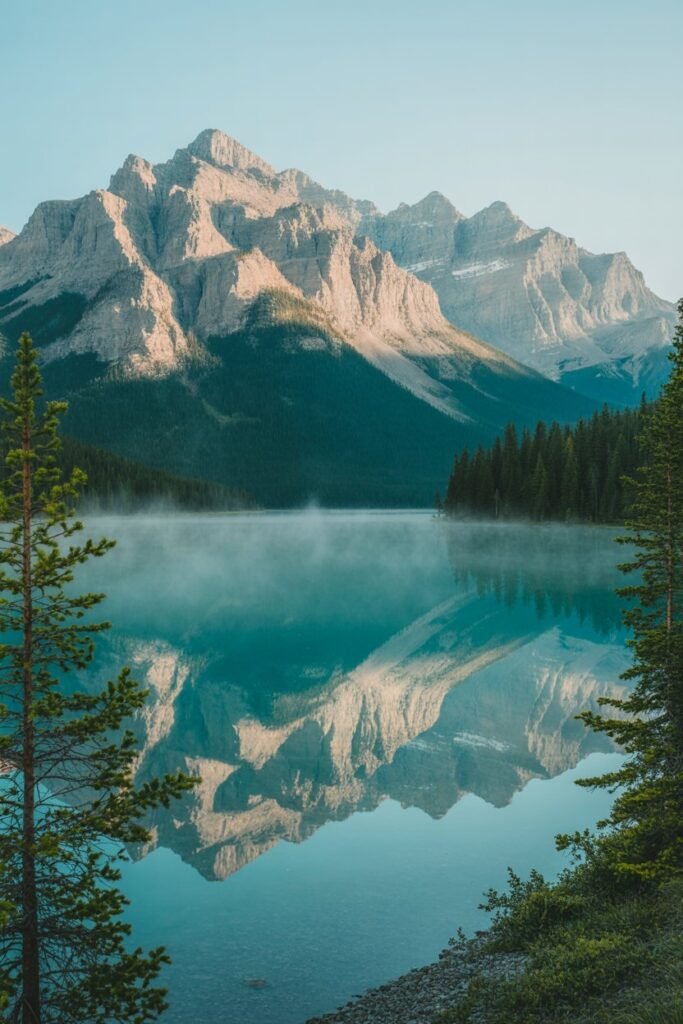
I still remember the first time I saw a photo of Banff.
I genuinely thought someone had edited the colors.
The water looked too blue.
The mountains looked too sharp.
The air looked too clean.
But standing there in person breathing in that cold alpine air I realized something important:
Nature doesn’t exaggerate. It just shows off.
Banff feels untouched. Wild. Almost sacred. It’s the kind of place where you wake up early without setting an alarm because you don’t want to miss a single second of light touching the peaks.
If Cinque Terre feels romantic, Banff feels powerful.
Where Exactly Is Banff National Park?
Banff National Park is located in Alberta, Canada, in the heart of the Canadian Rockies.
It is Canada’s first national park and one of the most scenic protected areas in the world.
The nearest major city and airport is:
- Calgary, Alberta (about 1.5 hours by car)
How to Get to Banff National Park
Step 1: Fly into Calgary International Airport (YYC)
Most international travelers will arrive through Calgary.
Step 2: Drive or Shuttle to Banff
From Calgary:
- Rent a car (highly recommended)
- Or take a shuttle service
- Travel time: About 90 minutes via the Trans-Canada Highway
Having a car gives you flexibility to explore lakes, viewpoints, and hiking trails at your own pace.
Why Banff Is One of the Most Beautiful Places in the World
There’s something about the color of the lakes here.
The turquoise waters of:
- Lake Louise
- Moraine Lake
look almost unreal.
That color comes from rock flour fine glacial sediment that reflects sunlight in a way that creates that signature glow.
But it’s not just the lakes.
It’s:
- Snow-dusted peaks
- Thick evergreen forests
- Wildlife roaming freely
- Mirror-like reflections at sunrise
- Endless scenic drives
Banff feels cinematic in every direction.
What To Do in Banff National Park
1. Visit Lake Louise at Sunrise
If there is one moment you should not miss, it’s sunrise at Lake Louise.
The water is calm.
The mountains reflect perfectly.
The light turns golden.
Arrive before 7 AM in peak season.
If you want a quiet experience, stay overnight at the nearby historic hotel:
Fairmont Chateau Lake Louise
Even if you don’t stay there, walking around the lake is unforgettable.
2. See Moraine Lake (Book in Advance)
Moraine Lake is arguably even more dramatic than Lake Louise.
Important: Private vehicle access is restricted during peak months. You must:
- Book a Parks Canada shuttle
- Or join a guided tour
- Or use approved transportation
Do not show up without a reservation during high season.
3. Drive the Icefields Parkway
The drive between Banff and Jasper is considered one of the most beautiful highways in the world.
You’ll pass:
- Glaciers
- Waterfalls
- Wildlife
- Massive mountain walls
Stop frequently. This drive isn’t meant to be rushed.
4. Hike for Unreal Views
Banff offers trails for every level.
Beginner-friendly:
- Lake Agnes Trail
Moderate:
- Johnston Canyon
Challenging:
- Plain of Six Glaciers
Always check trail conditions before heading out.
5. Soak in Banff Upper Hot Springs
After hiking, relax in the Banff Upper Hot Springs.
Warm mineral water surrounded by mountain views feels like the perfect reward.
Safety Tips for Banff National Park
Banff is stunning but it’s still wilderness.
Here’s what you need to know:
Wildlife Awareness
You may encounter:
- Elk
- Moose
- Bears
- Mountain goats
Never approach wildlife for photos.
Carry bear spray if hiking remote trails and know how to use it.
Weather Can Change Fast
Even in summer, temperatures can drop quickly.
Pack layers:
- Waterproof jacket
- Warm fleece
- Proper hiking shoes
Road Safety
Wildlife often crosses highways unexpectedly.
Drive carefully, especially at dawn and dusk.
How To Avoid Tourist Traps in Banff
Banff is popular — but you can still have a peaceful experience.
Here’s how:
- Visit in late May or September for fewer crowds.
- Arrive at lakes before 7 AM or after 6 PM.
- Explore less-visited spots like Peyto Lake.
- Avoid overpriced souvenir shops on Banff Avenue many sell imported goods.
Instead, look for local artisan stores.
What To Buy in Banff
Bring home something meaningful and regionally authentic:
- Canadian maple products
- Indigenous art (purchase from certified authentic sellers)
- Local handmade jewelry
- Glacier-inspired photography prints
- Canadian-made outdoor gear
Avoid mass-produced “Canada” souvenirs not made locally.
Best Time To Visit Banff
Summer (June–September):
- Best for hiking
- Lakes are vibrant turquoise
- Peak tourist season
Fall (September–October):
- Fewer crowds
- Beautiful autumn colors
Winter (December–March):
- Snow-covered landscapes
- Incredible for skiing
- Frozen lake beauty
Where To Stay
Banff Town:
- More restaurants and convenience
- Lively atmosphere
Lake Louise Area:
- Closer to iconic views
- More peaceful
Canmore:
- More affordable
- Less crowded
- 20 minutes from Banff
Personal Reflection
Banff changed how I see nature.
It reminded me that beauty doesn’t whisper — sometimes it roars.
Standing in front of those mountains makes your worries feel small in the best possible way.
It’s not a place you just visit.
It’s a place you feel.
And once you’ve seen that turquoise water in real life, regular blue just doesn’t hit the same anymore.
Read 22 Beautiful Places to Travel in Ireland That’ll Steal Your Heart
3. The Rose-Red Wonder of Petra, Jordan
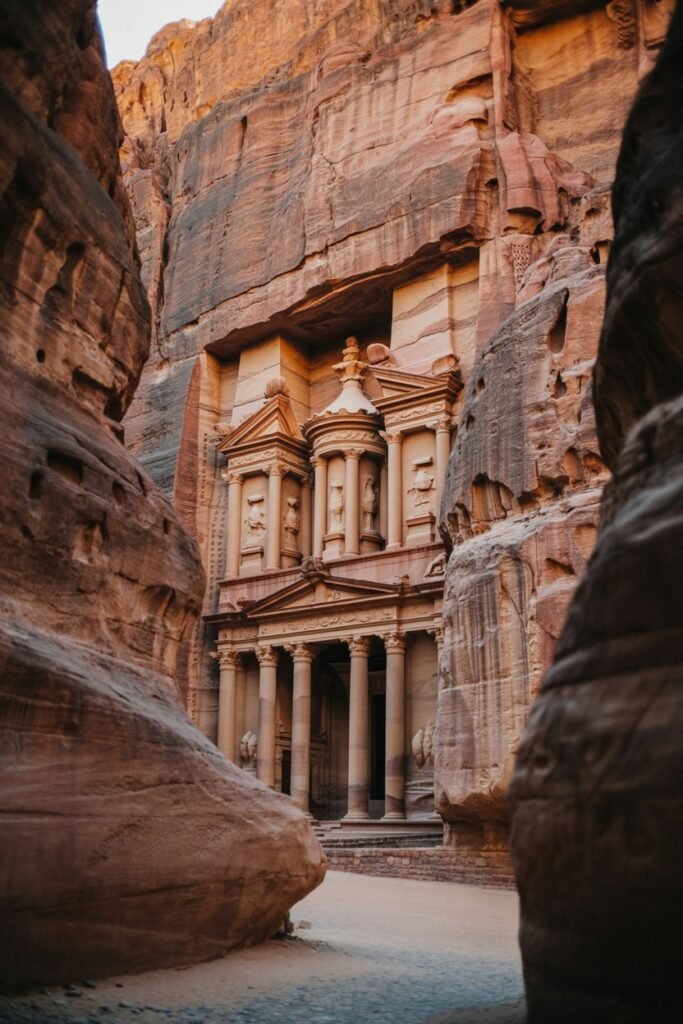
I remember the first time I saw Petra appear from between those narrow canyon walls.
You walk through silence at first. Just stone towering above you. Warm, golden light bouncing off cliffs. The path feels almost secretive, like the world is making you earn what’s ahead.
And then suddenly it opens.
And there it is.
The Treasury.
Carved directly into rose-colored rock.
For a few seconds, I genuinely forgot to breathe.
Petra doesn’t feel like a place someone built. It feels like a place the Earth allowed humans to borrow.
Where Exactly Is Petra?
Petra is located in southern Jordan, near the town of Wadi Musa.
Closest major city:
- Amman (Jordan’s capital)
Travel time:
- 3 to 4 hours by car from Amman
- About 2 hours from Aqaba
How To Get to Petra
Step 1: Fly into Amman
Most international travelers land at Queen Alia International Airport in Amman.
Step 2: Travel to Wadi Musa
Options include:
- Renting a car (most flexible option)
- Booking a private driver
- Taking a JETT bus (budget-friendly but limited schedule)
If you’re planning to explore other parts of Jordan like Wadi Rum or the Dead Sea, renting a car makes your trip much smoother.
Why Petra Is One of the Most Beautiful Places in the World
Petra is not just visually beautiful it’s emotionally powerful.
Carved over 2,000 years ago by the Nabataeans, the city is sculpted directly into sandstone cliffs that glow pink, red, and orange depending on the time of day.
It’s the scale that shocks you.
The detail that humbles you.
The silence that moves you.
And unlike many landmarks, Petra is not just one monument. It’s an entire ancient city hidden within desert canyons.
What To Do in Petra
1. Walk Through the Siq
The Siq is the narrow canyon that leads to the Treasury.
It stretches about 1.2 kilometers and feels cinematic.
Go slowly.
Look up at the rock formations.
Notice ancient carvings along the walls.
This walk builds anticipation and that’s part of the magic.
2. See The Treasury (Al-Khazneh)
The Treasury is Petra’s most iconic structure.
Arrive early (before 8 AM) to experience it without heavy crowds.
Stand quietly for a moment. Don’t rush to take photos immediately.
Let yourself feel the scale of it.
3. Hike to The Monastery (Ad-Deir)
If you think the Treasury is impressive, wait until you see The Monastery.
It requires climbing around 800 steps but the reward is absolutely worth it.
It’s larger, quieter, and far less crowded.
Pro tip: Go in the late afternoon when the stone glows warmly.
4. Explore the Royal Tombs
These massive tomb facades carved into cliffs are often overlooked by visitors rushing between major landmarks.
Take your time here.
They’re some of the most photogenic structures in Petra.
5. Experience Petra by Night
On select evenings, candles light the path to the Treasury.
It’s quieter, atmospheric, and deeply moving.
Just note: It’s more about ambiance than detailed sightseeing.
Safety Tips for Visiting Petra
Petra is generally very safe for tourists, but here are important tips:
- Wear proper walking shoes (you’ll walk 10–20 km easily).
- Bring plenty of water the desert heat is real.
- Use sunscreen and a hat.
- Avoid accepting unsolicited “free” guiding offers.
- Stay on marked paths to protect both yourself and the site.
Jordan as a whole is considered one of the safer countries in the region for travelers.
How To Avoid Tourist Traps in Petra
Petra is incredible but like any famous site, it has its traps.
Here’s how to avoid them:
Don’t Pay for “Secret” Shortcuts
Some locals may offer shortcuts to viewpoints for a fee.
Many are unnecessary.
Stick to official trails unless you book a certified guide.
Avoid Animal Rides
You may see donkey, horse, or camel rides offered inside Petra.
Some are not treated well.
If you choose to ride, ensure the animals appear healthy and well cared for.
Bring Your Own Snacks
Food inside Petra can be overpriced.
Pack light snacks from Wadi Musa before entering.
What To Buy in Petra (Authentic Souvenirs)
If you want meaningful souvenirs, consider:
- Handmade Bedouin jewelry
- Sand art bottles (handcrafted locally)
- Traditional keffiyeh scarves
- Olive wood carvings
- Authentic Jordanian spices
Avoid cheap “ancient coin” replicas sold aggressively many are mass-produced.
Best Time To Visit Petra
March to May:
- Pleasant temperatures
- Ideal for hiking
September to November:
- Warm but manageable
- Fewer crowds than spring
Avoid mid-summer (June–August) unless you can handle intense heat.
Where To Stay
Stay in Wadi Musa for easy access.
Options range from budget guesthouses to luxury stays.
For a special experience, look for hotels with balcony views overlooking the Petra mountains.
Personal Reflection
Petra didn’t just impress me.
It humbled me.
Standing in front of something carved thousands of years ago makes you realize how temporary we are and how powerful human creativity can be.
It’s not just beautiful.
It’s timeless.
And walking through those sandstone canyons feels like stepping into a story that’s still unfolding.
Read 12 Unique Cheap & Warm Winter Vacations in the USA That You Didn’t Think About
4. The Wild Beauty of Iceland
I’ll be honest I wasn’t prepared for how Iceland would make me feel.
It’s not the kind of beauty that gently unfolds.
It hits you immediately.
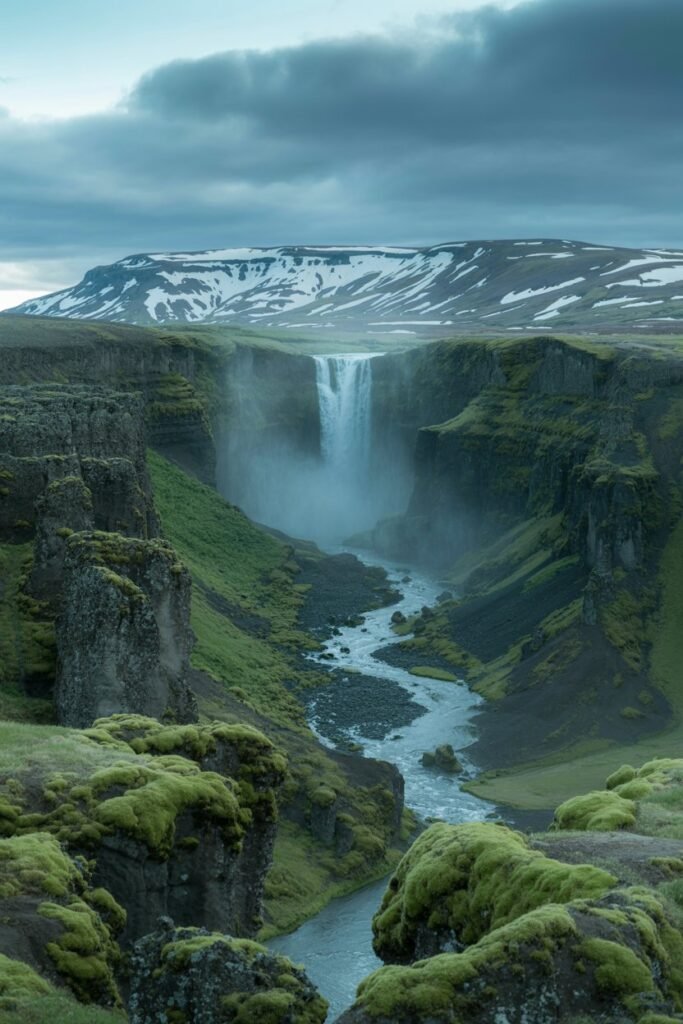
Black sand beaches.
Waterfalls crashing off cliffs.
Lava fields stretching for miles.
Steam rising from the earth like the planet is still alive and breathing.
Iceland doesn’t feel soft.
It feels raw. Untamed. Honest.
And that’s exactly what makes it unforgettable.
Where Exactly Is Iceland?
Iceland is a Nordic island nation located in the North Atlantic Ocean, between North America and Europe.
Its capital city is:
- Reykjavík
Most travelers begin their journey there.
How To Get to Iceland
Step 1: Fly into Keflavík International Airport (KEF)
This is the main international airport, located about 45 minutes from Reykjavík.
Step 2: Rent a Car
If there’s one piece of advice I cannot stress enough rent a car.
Iceland’s beauty is scattered across the country. Public transport is limited outside the capital, and guided tours can restrict your flexibility.
Having a car allows you to:
- Stop at random waterfalls
- Pull over for scenic views
- Explore at your own pace
- Avoid rigid tour schedules
Why Iceland Is One of the Most Beautiful Places in the World
Iceland feels like several planets in one country.
You’ll see:
- Glaciers
- Volcanoes
- Geysers
- Black sand beaches
- Moss-covered lava fields
- Ice caves
- Massive waterfalls
The contrast is unreal.
One minute you’re standing beside a roaring waterfall like Skógafoss.
The next, you’re walking along the dramatic black sands of Reynisfjara.
And if you visit in winter, you might witness the Northern Lights dancing above you.
It’s not curated beauty.
It’s primal beauty.
What To Do in Iceland
1. Drive the Golden Circle
The Golden Circle is the most popular route near Reykjavík.
It includes:
- Þingvellir National Park
- Geysir
- Gullfoss
You can drive it in one day, but I recommend taking it slow.
Walk beyond the main viewpoints.
Explore lesser-used paths.
Let yourself wander.
2. Visit the Blue Lagoon (But Strategically)
The famous Blue Lagoon is beautiful but it’s also one of Iceland’s biggest tourist hubs.
To avoid crowds:
- Book the first time slot of the day
- Or visit at sunset
- Reserve tickets well in advance
If you want a quieter alternative, consider smaller geothermal pools in rural areas.
3. Explore the South Coast
The South Coast is packed with dramatic scenery.
Highlights include:
- Seljalandsfoss (you can walk behind it)
- Jökulsárlón (floating icebergs)
- Diamond Beach
Diamond Beach looks like crystals scattered across black sand.
It doesn’t even look real.
4. Chase the Northern Lights
Best months:
- September to March
Drive away from city lights.
Use aurora forecast apps.
Be patient.
When the sky starts glowing green, it feels like the universe is performing just for you.
Safety Tips for Iceland
Iceland is one of the safest countries in the world but nature here demands respect.
Weather Changes Fast
It can go from sunshine to windstorm in minutes.
Check weather updates daily at official Icelandic weather services.
Stay on Marked Paths
Moss fields are delicate and take decades to regrow.
Stepping off marked paths damages the ecosystem.
Be Cautious Near Water
Sneaker waves at beaches like Reynisfjara can be dangerous.
Never turn your back to the ocean.
Keep a safe distance.
Winter Driving Requires Skill
If visiting in winter:
- Rent a 4×4
- Ensure proper winter tires
- Drive slowly and cautiously
How To Avoid Tourist Traps in Iceland
Iceland isn’t filled with typical tourist scams but you can still overspend easily.
Here’s how to be smart:
- Grocery shop instead of eating out every meal (restaurants are expensive).
- Visit lesser-known hot springs instead of only Blue Lagoon.
- Book tours directly through reputable operators.
- Travel shoulder season (May or September) for fewer crowds.
What To Buy in Iceland
If you want meaningful souvenirs, consider:
- Authentic Icelandic wool sweaters (lopapeysa)
- Local lava jewelry
- Icelandic sea salt
- Skincare products made with geothermal ingredients
- Handcrafted ceramics
Avoid cheap puffin-themed mass souvenirs made overseas.
Best Time To Visit Iceland
Summer (June–August):
- Midnight sun
- Easier driving
- Greener landscapes
Winter (November–March):
- Northern Lights
- Ice caves
- Snow-covered scenery
Shoulder Season (May & September):
- Fewer crowds
- Balanced experience
- Lower accommodation costs
Where To Stay
Reykjavík:
- Great for city atmosphere and restaurants
Vík:
- Ideal for South Coast exploration
Hofn:
- Perfect for glacier and lagoon access
Consider guesthouses or countryside cabins for a more intimate experience.
Personal Reflection
Iceland felt like stepping into a world that doesn’t care whether you’re impressed.
It just exists wild and magnificent.
There’s something grounding about standing near a waterfall so powerful you can feel the mist on your skin.
It reminds you that nature doesn’t perform for us.
We’re just lucky to witness it.
5. The Emerald Paradise of Raja Ampat, Indonesia
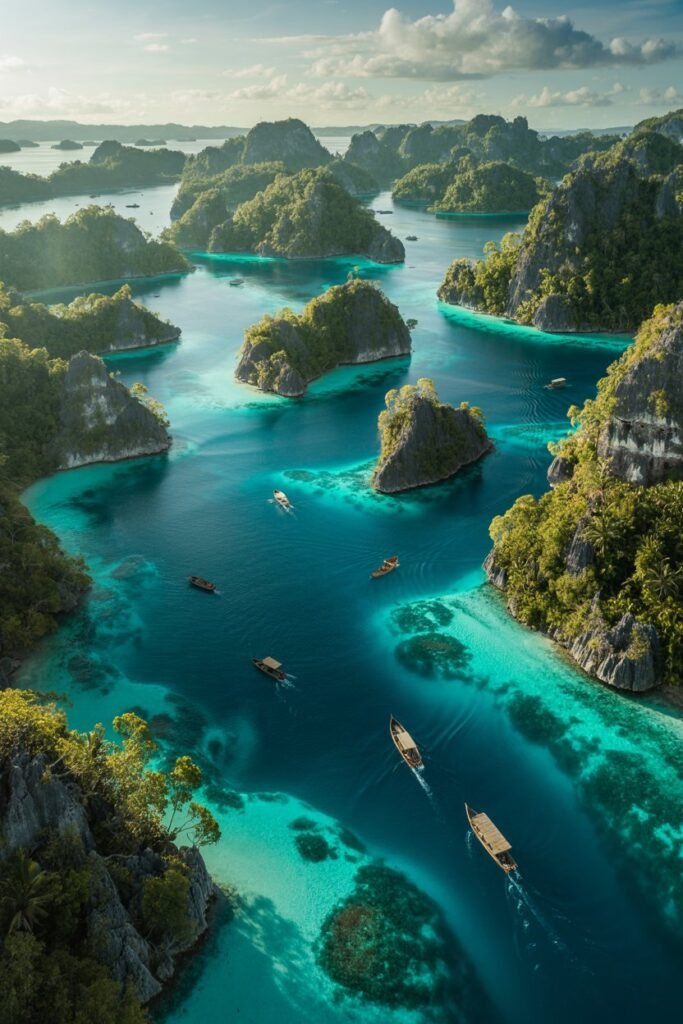
The first time I saw a photo of Raja Ampat, I thought it had to be edited.
Tiny jungle-covered islands scattered across impossibly clear turquoise water. Mist rising in the early morning. Sunlight reflecting off coral reefs beneath the surface.
It didn’t look real.
And then I realized something even more magical — very few places on Earth still look this untouched.
Raja Ampat isn’t loud.
It doesn’t shout for attention.
It whispers to people who are willing to travel just a little further.
And when you finally stand at one of its viewpoints, you understand why people call it one of the most beautiful places on the planet.
Where Exactly Is Raja Ampat?
Raja Ampat is located in the far eastern part of Indonesia, in West Papua province.
It’s made up of over 1,500 small islands, cays, and shoals scattered across crystal-clear waters.
The main access point is the small town of:
- Waisai
How To Get to Raja Ampat
Getting here takes effort and that’s part of why it’s still so pristine.
Step 1: Fly to Sorong
You’ll typically connect through Jakarta or Bali before reaching Sorong.
Step 2: Take a Ferry to Waisai
From Sorong:
- Take a public ferry (about 2 hours)
- Or arrange a private boat transfer through your resort
Many eco-lodges also arrange pick-ups directly from Sorong.
Yes, it’s remote. But once you arrive, you’ll understand why it was worth every connection.
Why Raja Ampat Is One of the Most Beautiful Places in the World
Raja Ampat is often described as the most biodiverse marine ecosystem on Earth.
But beyond statistics, what truly makes it breathtaking is the combination of:
- Limestone karst islands rising dramatically from the sea
- Clear turquoise water that reveals coral reefs below
- Dense jungle landscapes
- Complete silence, broken only by waves and birds
When you climb to viewpoints like Piaynemo, you see clusters of tiny islands scattered like emerald jewels across bright blue water.
It doesn’t feel like a beach destination.
It feels like discovering a secret.
What To Do in Raja Ampat
1. Climb the Piaynemo Viewpoint
This is the iconic Raja Ampat view.
A short but steep staircase leads to a panoramic platform overlooking dozens of limestone islands.
Go early in the morning to avoid heat and tour groups.
This is one of those places where photos barely capture the scale.
2. Snorkel in Crystal-Clear Water
Even if you’re not a diver, snorkeling here is unforgettable.
The coral reefs are vibrant and alive.
You may see:
- Sea turtles
- Reef sharks
- Colorful tropical fish
- Giant clams
The water visibility is often exceptional.
3. Go Scuba Diving (If Certified)
Raja Ampat is considered one of the best dive destinations in the world.
Diving here reveals:
- Manta rays
- Wobbegong sharks
- Schools of barracuda
- Pristine coral ecosystems
If you’re serious about diving, this is bucket-list level.
4. Stay in an Overwater Eco-Lodge
Unlike large commercial resorts, many accommodations here are locally owned eco-lodges.
Staying in a simple wooden bungalow over the water, waking up to the sound of the ocean that’s part of the experience.
Luxury here is simplicity.
5. Visit Local Villages
Raja Ampat is home to small Papuan communities.
Visit respectfully.
Ask before taking photos.
Support local businesses when possible.
Cultural experiences here are intimate and meaningful.
Safety Tips for Raja Ampat
Raja Ampat is safe, but it’s remote so preparation matters.
Health & Medical
- Bring essential medications (medical facilities are limited).
- Travel insurance is highly recommended.
- Pack reef-safe sunscreen.
Ocean Safety
- Follow dive guides strictly.
- Be aware of currents.
- Do not touch coral it damages ecosystems and can cut you.
Weather Awareness
The sea can become rough during certain months.
Check conditions before boat transfers.
How To Avoid Tourist Traps in Raja Ampat
Because it’s less commercialized, traps are minimal but here’s how to stay smart:
- Book through reputable eco-lodges.
- Avoid extremely cheap dive operators (quality matters here).
- Confirm what’s included (meals, transfers, dive fees).
- Be mindful of marine park fees these are official and help conservation.
The biggest “trap” here is underestimating costs remote locations are naturally more expensive.
What To Buy in Raja Ampat
Souvenirs here are more about supporting local communities.
Consider:
- Handmade woven bags
- Shell crafts (ethically sourced)
- Local carvings
- Natural sea salt products
- Small-scale art from local artisans
Avoid buying coral or marine wildlife products even if offered.
Best Time To Visit Raja Ampat
October to April:
- Calmer seas
- Best diving conditions
May to September:
- Slightly rougher waters
- Fewer tourists
Because of its location, Raja Ampat doesn’t follow typical Southeast Asia monsoon patterns exactly.
Where To Stay
Options range from:
- Simple eco-lodges (authentic experience)
- Boutique island resorts
- Liveaboard diving boats
Expect:
- Limited WiFi
- Simple but beautiful accommodations
- Stunning natural surroundings
Personal Reflection
Raja Ampat made me slow down.
There’s no rushing here.
No big nightlife.
No over-commercialized streets.
Just water.
Sky.
Silence.
It reminded me that beauty doesn’t need infrastructure.
Sometimes it’s enough to sit on a wooden dock, feet in warm water, watching the sun sink behind islands that feel like they’ve existed forever.
Raja Ampat isn’t flashy.
It’s pure.
And that purity is rare.
6. The Untamed Wilderness of Serengeti National Park, Tanzania
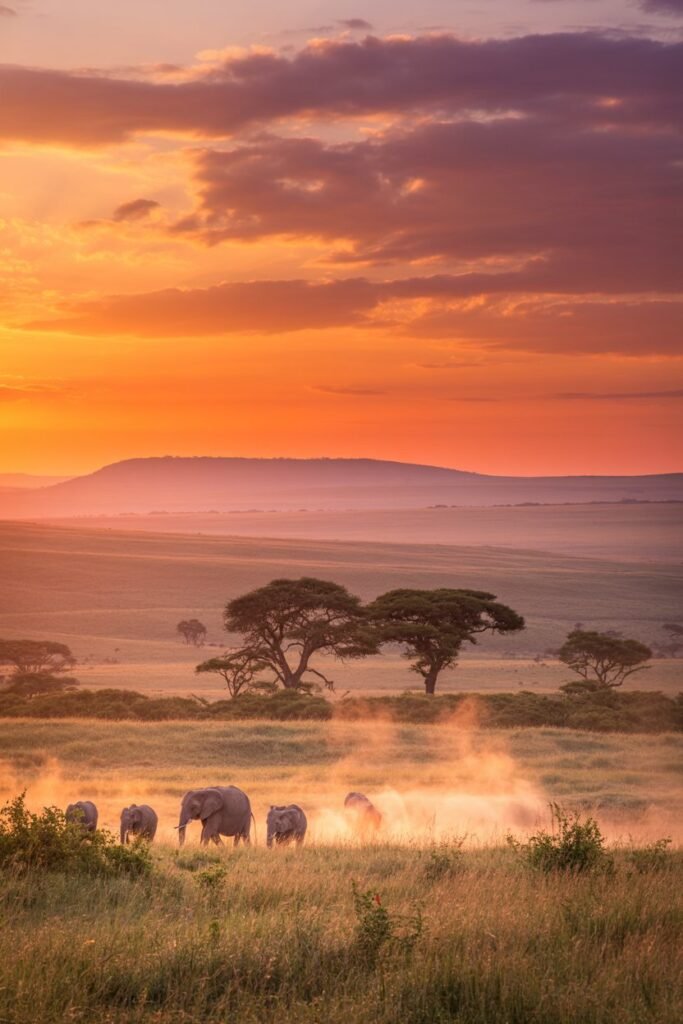
There’s something about standing in the Serengeti at sunset that changes you.
The sky turns deep orange.
The grass glows gold.
And somewhere in the distance, you hear a lion roar.
It’s not dramatic in a loud way.
It’s dramatic in a way that makes your heart beat differently.
The Serengeti doesn’t offer curated beauty. It offers raw, breathing, untamed life. And that kind of beauty stays with you long after you leave.
Where Exactly Is the Serengeti?
The Serengeti National Park is located in northern Tanzania, East Africa.
It borders:
- Maasai Mara in Kenya (to the north)
The nearest major city:
- Arusha
How To Get to the Serengeti
Step 1: Fly into Kilimanjaro International Airport (JRO)
This airport serves northern Tanzania and is the main entry point for safari travelers.
Step 2: Transfer to Arusha
Most safari trips begin in Arusha, which acts as the gateway to Tanzania’s northern safari circuit.
Step 3: Reach the Serengeti
You can access the Serengeti by:
- Small domestic flight directly into airstrips within the park
- Or 4×4 safari vehicle (about 6–8 hours by road)
If time allows, I recommend the road journey. Watching the landscape change gradually adds to the experience.
Why the Serengeti Is One of the Most Beautiful Places in the World
The Serengeti isn’t just visually beautiful it’s emotionally powerful.
It’s one of the few places on Earth where you can witness:
- The Great Migration (millions of wildebeest and zebras moving across the plains)
- Lions lounging in tall grass
- Elephants walking in family groups
- Giraffes silhouetted against sunset skies
- Cheetahs scanning the horizon
The beauty here isn’t about architecture or water clarity.
It’s about life.
Endless, wild, and unfiltered life.
What To Do in the Serengeti
1. Go on a Sunrise Game Drive
There is nothing like starting your day before dawn.
You head out in a 4×4.
The air is cool.
The sky slowly brightens.
Predators are most active early in the morning, so this is prime wildlife viewing time.
You may see:
- Lions returning from a hunt
- Hyenas roaming
- Leopards resting in trees
The stillness is unforgettable.
2. Witness the Great Migration
If you time your visit right, you can see one of nature’s greatest spectacles.
The migration typically moves through the Serengeti between:
- December to July (depending on rainfall patterns)
Seeing thousands of animals moving together across the plains is something you will never forget.
3. Take a Hot Air Balloon Safari
This is one of the most magical ways to see the Serengeti.
Floating silently above the plains at sunrise while herds move below you feels surreal.
It’s expensive but if your budget allows, it’s worth every dollar.
4. Visit a Maasai Village (Respectfully)
Some tours offer cultural visits to Maasai communities.
If you choose to go:
- Ensure the visit is ethical and community-supported.
- Be respectful.
- Ask before taking photos.
Cultural exchange should feel meaningful, not staged.
Safety Tips for Visiting the Serengeti
The Serengeti is safe but remember, it’s true wilderness.
Always Follow Your Guide’s Instructions
Never:
- Exit the vehicle unless permitted
- Approach wildlife
- Make loud noises
Your guide understands animal behavior trust them.
Health & Preparation
- Yellow fever vaccination may be required (check before travel).
- Malaria prevention is recommended.
- Use insect repellent.
- Stay hydrated in the heat.
Travel Insurance Is Essential
Safaris take place in remote areas. Comprehensive insurance is important.
How To Avoid Tourist Traps in the Serengeti
The Serengeti is not a place filled with souvenir traps — but there are things to watch out for:
- Avoid extremely cheap safari packages (quality and safety matter).
- Research tour companies thoroughly.
- Make sure park fees are included in your quote.
- Choose smaller safari groups for a more intimate experience.
The experience here should feel immersive, not rushed.
What To Buy in the Serengeti
Support local artisans where possible.
Consider:
- Handmade Maasai beadwork
- Locally carved wooden sculptures
- Traditional fabrics
- African art prints
- Fair-trade crafts
Avoid purchasing items made from wildlife products (ivory, animal skins).
Best Time To Visit the Serengeti
June to October:
- Dry season
- Best wildlife viewing
- Cooler temperatures
December to March:
- Calving season
- Excellent predator sightings
April & May:
- Heavy rains
- Fewer tourists
- Lower prices
Where To Stay
Accommodation ranges from:
- Luxury tented camps
- Mobile migration camps
- Mid-range safari lodges
- Budget campsites
Luxury camps offer:
- Spacious canvas tents
- Private decks
- Stunning sunset views
And trust me hearing wildlife at night from your tent is an experience in itself.
Personal Reflection
The Serengeti made me realize something important.
We don’t just travel to see landscapes.
We travel to feel alive.
Watching elephants move across golden grasslands under a burning sunset reminded me that nature doesn’t perform for us it simply exists in its own rhythm.
And being invited into that rhythm, even briefly, feels like a privilege.
The Serengeti isn’t polished.
It’s powerful.
And that power is breathtaking.
7. The Fairytale Peaks of Swiss Alps, Switzerland
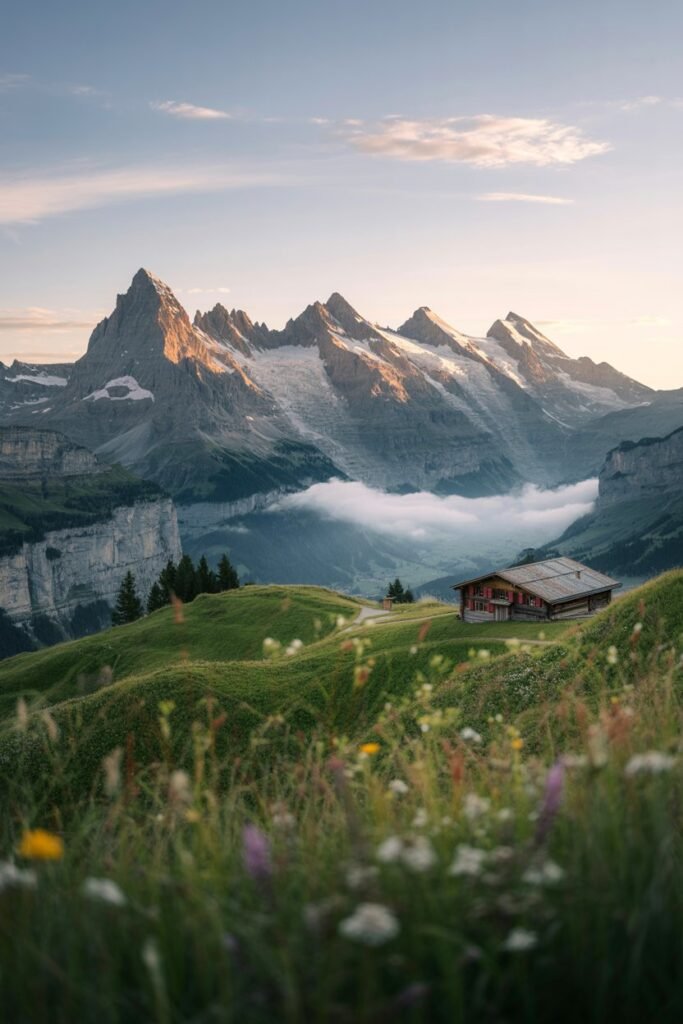
I still remember the first morning I woke up in the Swiss Alps.
I pulled the curtains back slowly and for a second, I thought I was looking at a painting.
Sharp, snow-capped peaks.
Rolling green meadows.
Wooden chalets with flower-filled balconies.
Cowbells echoing softly in the distance.
It felt peaceful in a way that’s hard to explain.
The Swiss Alps aren’t dramatic in a chaotic way like Iceland.
They’re dramatic in a perfectly composed, almost unreal way.
Every angle looks designed.
Every village looks intentional.
Every train ride feels cinematic.
And yet, it’s completely natural.
Where Exactly Are the Swiss Alps?
The Swiss Alps stretch across southern Switzerland and include some of the most iconic mountain scenery in Europe.
Popular base towns include:
- Zermatt
- Interlaken
- Lauterbrunnen
Each offers a slightly different experience but all are stunning.
How To Get to the Swiss Alps
Step 1: Fly into Zurich or Geneva
Both cities have major international airports.
- Zurich works well for central and eastern Alps.
- Geneva is ideal for western regions.
Step 2: Take a Scenic Train
Switzerland’s train system is one of the best in the world.
You don’t need a car here.
In fact, I recommend you don’t rent one.
Trains connect almost every alpine town seamlessly, and the journey itself is part of the beauty.
Why the Swiss Alps Are One of the Most Beautiful Places in the World
The beauty here is balanced.
Glacial peaks tower above emerald valleys.
Waterfalls cascade down sheer cliffs.
Lakes reflect mountains like mirrors.
One of the most iconic sights is the Matterhorn a perfectly shaped pyramid peak rising dramatically above Zermatt.
Then there’s Lauterbrunnen Valley, which looks like something straight out of a fantasy film with 72 waterfalls flowing down towering rock faces.
The Swiss Alps feel serene.
Orderly.
Majestic.
It’s nature at its most photogenic.
What To Do in the Swiss Alps
1. Ride the Scenic Mountain Trains
One of the best ways to experience the Alps is by panoramic train.
Routes like:
- Glacier Express
- Bernina Express
Offer floor-to-ceiling views of mountains, valleys, and glaciers.
Even if you’re not hiking, you’ll still see incredible scenery.
2. Visit Jungfraujoch (Top of Europe)
From Interlaken, you can take a train up to Jungfraujoch one of the highest railway stations in Europe.
Expect:
- Snow year-round
- Glacier views
- Crisp alpine air
It’s expensive but the views are unforgettable.
Go early to avoid crowds.
3. Explore Lauterbrunnen Valley
Lauterbrunnen is one of the most beautiful valleys in Europe.
Walk through:
- Flower-covered meadows
- Wooden bridges
- Villages that feel frozen in time
Visit Staubbach Falls one of the tallest free-falling waterfalls in Europe.
4. Hike with Mountain Views
There are trails for every fitness level.
Beginner-friendly scenic hikes:
- Panorama trails near Murren
- Lake walks in Zermatt
Moderate hikes:
- Five Lakes Walk (Zermatt area)
Always check weather conditions before heading out.
5. Visit Alpine Lakes
Switzerland is filled with breathtaking lakes like:
- Lake Brienz
- Lake Lucerne
- Oeschinen Lake
Clear turquoise water surrounded by mountains feels surreal.
Safety Tips for the Swiss Alps
Switzerland is very safe, but mountain environments require awareness.
Weather Awareness
Conditions can change quickly in higher altitudes.
Bring:
Stay on Marked Trails
Alpine terrain can be dangerous if you stray off path.
Follow official hiking signs.
Altitude Awareness
If visiting high-altitude areas like Jungfraujoch:
- Move slowly
- Drink water
- Take breaks
How To Avoid Tourist Traps in the Swiss Alps
Switzerland isn’t scam-heavy but it can be expensive.
Here’s how to avoid overspending:
- Buy a Swiss Travel Pass if traveling extensively by train.
- Stay in smaller villages instead of major cities.
- Eat at local bakeries instead of hotel restaurants.
- Visit popular viewpoints early in the morning.
Avoid souvenir shops directly near train stations prices are higher.
What To Buy in the Swiss Alps
Bring home something authentic and locally made:
- Swiss chocolate (buy from artisan chocolatiers)
- Swiss army knives (official stores only)
- Handmade cowbells
- Local cheese (if allowed through customs)
- Alpine skincare products
Avoid cheap imported trinkets labeled “Swiss style.”
Best Time To Visit the Swiss Alps
June to September:
- Green landscapes
- Ideal hiking weather
- Clear mountain views
December to March:
- Snowy fairytale scenery
- Ski season
- Cozy chalet vibes
Late September:
- Fewer tourists
- Crisp air
- Beautiful light for photography
Where To Stay
Zermatt:
- Iconic Matterhorn views
- Car-free village charm
Interlaken:
- Central base for exploring
Lauterbrunnen:
- Quiet, scenic, and storybook-like
Consider small chalet-style hotels for an authentic alpine experience.
Personal Reflection
The Swiss Alps made me slow down in a different way than Raja Ampat did.
Here, beauty feels precise.
Balanced.
Almost composed like a classical symphony.
Sitting on a balcony with hot chocolate, watching clouds drift across mountain peaks, I felt something I don’t always feel when traveling:
Peace.
Not excitement.
Not adrenaline.
Just peace.
And sometimes, that kind of beauty is the most powerful of all.
Read 3 Days in Los Angeles Itinerary – Perfect for First-Timers
8. The Timeless Temples of Angkor Wat, Cambodia
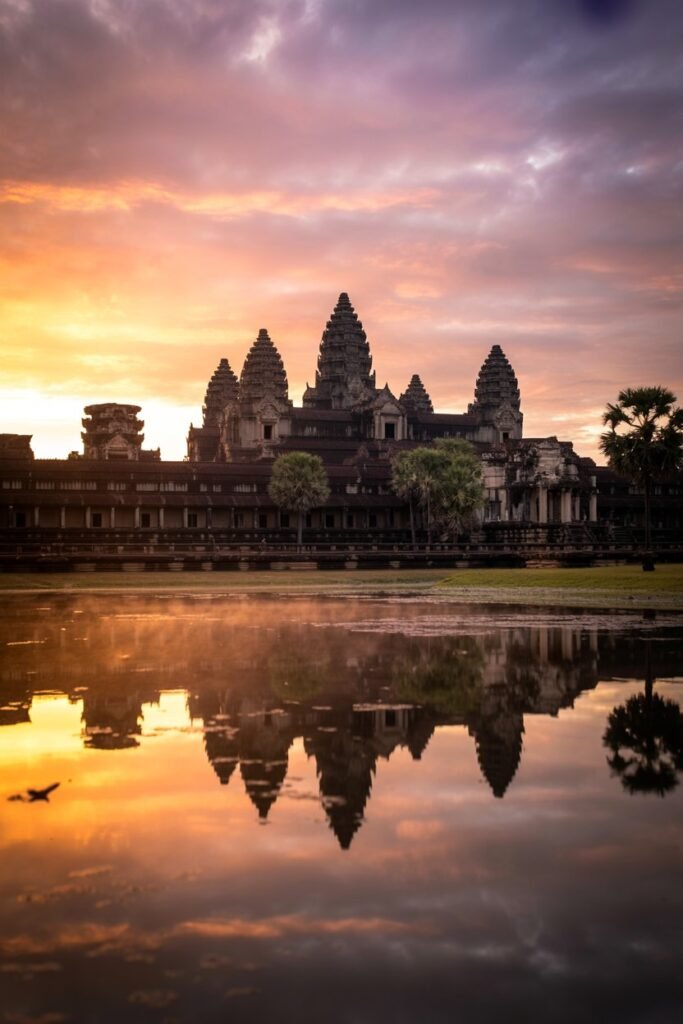
I didn’t expect Angkor Wat to feel so emotional.
You wake up before sunrise. It’s still dark. The air is humid and quiet. You walk toward a silhouette rising against the sky.
And slowly as the sun begins to glow the towers appear.
Reflected in still water.
Wrapped in mist.
It doesn’t feel like a tourist attraction.
It feels like stepping into another era.
Angkor Wat isn’t just beautiful because of its architecture.
It’s beautiful because it has endured.
Where Exactly Is Angkor Wat?
Angkor Wat is located near the city of:
- Siem Reap
In northwestern Cambodia.
It’s part of a massive archaeological park that spans over 400 square kilometers far larger than most visitors realize.
How To Get to Angkor Wat
Step 1: Fly into Siem Reap International Airport
Siem Reap has direct connections from major Southeast Asian cities like Bangkok, Singapore, and Kuala Lumpur.
Step 2: Stay in Siem Reap
The temple complex is about 15–20 minutes from the town center.
Transportation options include:
- Tuk-tuk (most popular)
- Bicycle (for adventurous travelers)
- Private car with driver
- Guided tour
I recommend hiring a tuk-tuk driver for the day affordable and flexible.
Why Angkor Wat Is One of the Most Beautiful Places in the World
Angkor Wat is the largest religious monument in the world.
But what makes it breathtaking isn’t just size.
It’s the detail.
Every wall is carved with intricate bas-reliefs.
Every tower has symbolic meaning.
Every corridor feels endless.
And beyond Angkor Wat itself, the Angkor Archaeological Park includes dozens of temples some restored, some overtaken by jungle.
Places like:
- Ta Prohm (where massive tree roots wrap around stone walls)
- Bayon Temple (famous for its giant stone faces)
It feels like architecture merging with nature in the most poetic way.
What To Do at Angkor Wat
1. Watch Sunrise at Angkor Wat
Yes, it’s popular.
But it’s popular for a reason.
Arrive before 5:00 AM.
Stand by the reflection pools.
Watch the sky change from indigo to orange.
Pro tip: Walk slightly away from the main crowd for a quieter viewpoint.
2. Explore Ta Prohm
Ta Prohm feels mysterious.
Gigantic tree roots wrap around temple walls, creating an almost cinematic atmosphere.
It’s less symmetrical than Angkor Wat — more chaotic, more organic.
Go mid-morning before tour buses arrive.
3. Visit Bayon Temple
Bayon is surreal.
Giant stone faces look down from towers in every direction.
It feels almost spiritual.
Walk slowly. Notice the carvings. Look closely at the expressions.
4. Cycle Through the Temple Complex
If you enjoy active exploring, rent a bicycle and ride between temples.
Early morning cycling through jungle-lined paths feels magical.
Just prepare for heat.
5. Stay for Sunset
Phnom Bakheng is a popular sunset spot but it gets crowded.
Alternatively, ask your driver for quieter sunset viewpoints.
Safety Tips for Angkor Wat
Cambodia is generally safe for travelers, but preparation matters.
Heat & Hydration
Temperatures can exceed 35°C (95°F).
Bring:
- Water
- Hat
- Sunscreen
- Light, breathable clothing
Temple Safety
Some staircases are steep and narrow.
Wear sturdy shoes.
Take your time climbing.
Respect Cultural Norms
Angkor Wat is still a sacred site.
Dress modestly:
- Covered shoulders
- Covered knees
How To Avoid Tourist Traps
Angkor Wat can get crowded but you can avoid the worst of it.
- Buy official tickets only at the official ticket center.
- Avoid unofficial “guides” approaching you aggressively.
- Visit outer temples beyond the main circuit.
- Start early (before 7 AM).
- Don’t eat at restaurants directly outside main entrances head back to Siem Reap for better value.
What To Buy in Siem Reap
Support local artisans when possible.
Consider:
- Handmade silk scarves
- Traditional Cambodian art
- Silver jewelry
- Palm sugar products
- Cambodian spices
Visit artisan markets instead of generic souvenir stalls.
Avoid buying ancient-looking artifacts exporting genuine antiquities is illegal.
Best Time To Visit Angkor Wat
November to February:
- Cooler temperatures
- Dry season
- Best overall conditions
March to May:
- Very hot
June to October:
- Rainy season
- Lush greenery
- Fewer crowds
Even in rainy season, showers are often brief and dramatic rather than all-day rain.
Where To Stay
Siem Reap offers excellent value for money.
Options range from:
- Boutique heritage hotels
- Luxury resorts
- Budget guesthouses
Many hotels offer:
- Beautiful pools
- Spa treatments
- Complimentary breakfast
After a long temple day, that pool feels like heaven.
Personal Reflection
Angkor Wat made me reflect on time.
On how civilizations rise and fall.
On how something built centuries ago can still feel alive.
Walking through quiet temple corridors as sunlight filters through stone windows feels deeply grounding.
It’s not flashy beauty.
It’s layered.
Textured.
Soulful.
And standing there at sunrise, watching history glow gold, I realized something:
Some places don’t just impress you.
They stay with you.
9. The Golden Dunes of Sossusvlei, Namibia
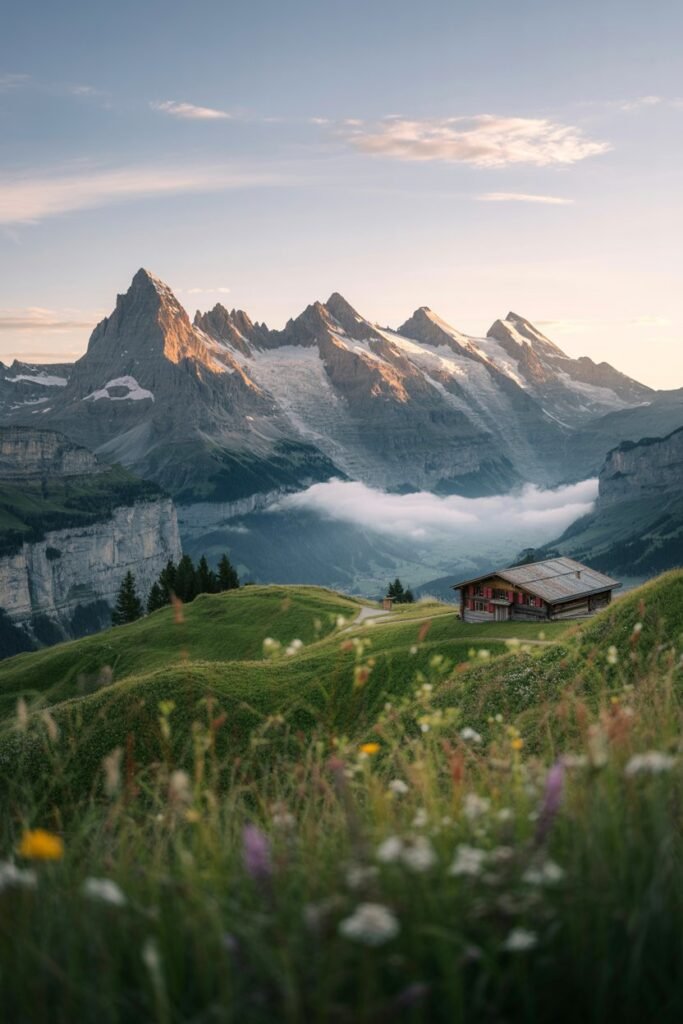
I still remember the first time I saw a photo of Sossusvlei.
The dunes looked almost unreal like waves frozen in time.
Burnt orange sand rising hundreds of feet into the sky. Sharp ridgelines cutting into blue emptiness. White clay pans cracked and dry. And the haunting silhouettes of ancient dead trees standing against the horizon.
It didn’t look like Earth.
And when I finally stood there in person, walking across the cool sand before sunrise, I realized something:
This is what silence looks like.
Where Exactly Is Sossusvlei?
Sossusvlei is located inside:
- Namib-Naukluft National Park
In southwestern Namibia.
It’s part of the Namib Desert one of the oldest deserts in the world.
The nearest city:
- Windhoek (about 5–6 hours by car)
How To Get to Sossusvlei
Step 1: Fly into Windhoek
Most international travelers arrive at Hosea Kutako International Airport near Windhoek.
Step 2: Rent a 4×4 Vehicle
Driving is the most common way to reach Sossusvlei.
The journey takes about 5–6 hours.
Roads are mostly gravel a 4×4 is highly recommended.
Alternatively:
- Book a guided desert tour
- Or stay at a lodge offering transfers
The drive itself is part of the experience vast landscapes, open skies, and almost no traffic.
Why Sossusvlei Is One of the Most Beautiful Places in the World
Sossusvlei is visually extreme.
The contrast is stunning:
- Deep red dunes
- Stark white salt pans
- Blackened camel thorn trees
- Bright blue sky
One of the most iconic dunes here is:
- Dune 45
And the famous clay pan filled with ancient trees is:
- Deadvlei
These trees are over 600 years old preserved by the dry desert climate.
The beauty here is minimalist.
No skyscrapers.
No lush greenery.
No distractions.
Just form.
Light.
Shadow.
And space.
So much space.
What To Do in Sossusvlei
1. Climb Dune 45 at Sunrise
Arrive at the park gates before sunrise.
Climb along the ridge — not straight up the side.
The sand glows fiery orange as the sun rises.
Yes, it’s physically demanding.
Yes, it’s worth it.
Standing at the top, watching shadows stretch across the desert, feels surreal.
2. Visit Deadvlei
Deadvlei is otherworldly.
The cracked white ground contrasts sharply with dark tree skeletons and towering red dunes.
This is one of the most photographed places in Africa and for good reason.
Go early to avoid extreme heat and crowds.
3. Drive to Sossusvlei Pan
The final stretch of road requires 4×4 driving through deep sand.
If you’re unsure, park and take a shuttle offered inside the park.
The last thing you want is to get stuck in desert sand.
4. Stargazing at Night
Namibia has some of the darkest skies in the world.
At night, the stars look overwhelming.
No light pollution.
No city glow.
Just endless sky.
This alone makes the trip worth it.
Safety Tips for Sossusvlei
This is desert terrain preparation is everything.
Hydration Is Critical
Bring more water than you think you need.
The heat rises quickly after sunrise.
Avoid Midday Hiking
Temperatures can exceed 40°C (104°F).
Plan activities early morning or late afternoon.
Vehicle Safety
- Carry spare tires.
- Fuel up before leaving Windhoek.
- Download offline maps.
There are long stretches with no services.
How To Avoid Tourist Traps
Sossusvlei isn’t commercialized but here’s how to stay smart:
- Book park entry permits in advance.
- Stay inside or near the park for early access.
- Avoid overpriced lodge gift shops buy crafts in Windhoek or local communities.
- Don’t overpay for “private dune tours” unless they offer genuine value.
The beauty here doesn’t need embellishment.
What To Buy in Namibia
Support local artisans and ethical products.
Consider:
- Handmade Himba jewelry
- Local woven baskets
- Namibian gemstones (from reputable sellers)
- Wood carvings
- Natural desert-inspired skincare
Avoid buying items made from endangered wildlife materials.
Best Time To Visit Sossusvlei
May to October:
- Cooler temperatures
- Clear skies
- Ideal for desert exploration
November to April:
- Hotter
- Possible afternoon thunderstorms
- Fewer tourists
Winter months (June–August) offer cold mornings but comfortable daytime temperatures.
Where To Stay
Options include:
- Luxury desert lodges
- Eco-friendly camps
- Self-drive campsites
Staying inside Namib-Naukluft National Park allows earlier dune access — a huge advantage.
Waking up in a desert lodge as the sun rises over red dunes feels peaceful in a way few places can match.
Personal Reflection
Sossusvlei made me understand something about beauty.
It doesn’t always need color.
It doesn’t always need movement.
Sometimes beauty is about contrast.
About simplicity.
Standing alone in that vast desert, hearing nothing but wind across sand, I felt incredibly small but also incredibly grounded.
The dunes will still be there long after we’re gone.
And that kind of timelessness?
It’s breathtaking.
10. The Dramatic Coastline of Rio de Janeiro, Brazil
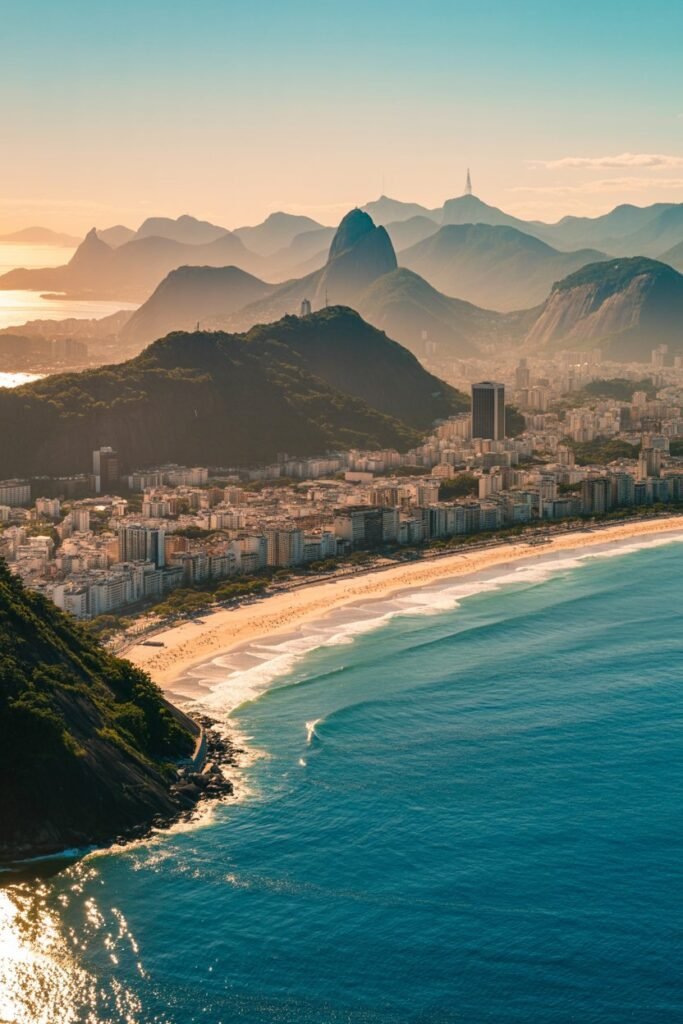
The first time I saw Rio from above, I understood why people fall in love with it instantly.
Granite mountains rising straight out of the ocean.
White sand beaches curving around turquoise water.
A giant statue watching over the city from above.
And neighborhoods buzzing with music and life.
Rio doesn’t try to be beautiful.
It simply is.
There’s something about the way the city blends mountains, jungle, and sea that feels almost cinematic.
And yet, it’s real.
Where Exactly Is Rio de Janeiro?
Rio de Janeiro is located on the southeastern coast of Brazil, along the Atlantic Ocean.
It’s one of the most famous cities in South America and one of the most visually dramatic urban settings in the world.
How To Get to Rio de Janeiro
Step 1: Fly into Galeão International Airport (GIG)
Most international travelers arrive at Rio’s main international airport.
Step 2: Stay in the Right Neighborhood
The most convenient and scenic areas for visitors are:
- Copacabana
- Ipanema
- Leblon
These neighborhoods are beachfront, lively, and well-located.
I personally recommend Ipanema if you want beauty with slightly fewer crowds than Copacabana.
Why Rio Is One of the Most Beautiful Places in the World
Rio’s beauty is about contrast.
You have:
- Towering mountains like Sugarloaf Mountain rising dramatically from the sea
- The iconic statue of Christ the Redeemer overlooking the city
- Famous beaches like Ipanema Beach
- Lush rainforest inside the city at Tijuca National Park
Very few cities in the world combine ocean, mountains, jungle, and urban life so seamlessly.
You can hike in the morning.
Swim in the afternoon.
Watch sunset from a mountaintop.
Dance at night.
It’s vibrant beauty.
Alive beauty.
What To Do in Rio de Janeiro
1. Visit Christ the Redeemer Early
The statue sits atop Corcovado Mountain and offers panoramic views of the entire city.
Go as early as possible to avoid crowds and midday heat.
Book official tickets online in advance.
Standing there with Rio stretched beneath you feels unforgettable.
2. Ride the Cable Car to Sugarloaf Mountain
The cable car ride to Sugarloaf is one of the most scenic experiences in the city.
Go around sunset.
Watching the sky turn pink over Guanabara Bay is magical.
3. Relax on Ipanema Beach
Ipanema feels iconic for a reason.
Golden sand.
Mountain backdrop.
Vibrant atmosphere.
Bring sunscreen and stay aware of your belongings (more on safety below).
4. Hike in Tijuca National Park
Tijuca is one of the largest urban rainforests in the world.
You can hike to waterfalls and scenic viewpoints like Vista Chinesa.
It’s incredible to find dense jungle inside a major city.
5. Explore Santa Teresa
This historic neighborhood has:
- Colorful streets
- Artistic vibe
- Boutique cafes
- Colonial architecture
It feels charming and creative.
Safety Tips for Rio
Rio is stunning but awareness is important.
Be Mindful of Belongings
- Avoid displaying expensive jewelry.
- Don’t carry large amounts of cash.
- Use a crossbody bag.
- Avoid walking alone late at night in isolated areas.
Stick to well-known neighborhoods.
Use Official Transportation
- Use registered taxis or ride-hailing apps.
- Avoid unmarked taxis.
- Don’t accept rides from strangers.
Beach Awareness
Keep valuables minimal at the beach.
If possible, bring only essentials.
How To Avoid Tourist Traps in Rio
Rio isn’t filled with classic tourist scams, but you can overpay if not careful.
- Buy official tickets for attractions.
- Avoid unofficial street vendors selling “discount tours.”
- Eat at local churrascarias (Brazilian steakhouses) instead of tourist-heavy beachfront restaurants.
- Explore beyond Copacabana to discover more authentic experiences.
What To Buy in Rio
Bring home something meaningful.
Consider:
- Brazilian Havaianas (buy from official stores)
- Local beachwear brands
- Brazilian coffee
- Handmade jewelry
- Carnival-inspired art
Avoid cheap “I ❤️ Rio” mass souvenirs made overseas.
Best Time To Visit Rio
May to October:
- Cooler temperatures
- Less humidity
- Ideal for sightseeing
December to March:
- Hot and humid
- Carnival season (incredible energy but crowded and expensive)
If you want vibrant atmosphere without peak chaos, consider shoulder months like April or November.
Where To Stay
Ipanema:
- Beautiful and slightly more upscale
- Great restaurants
Copacabana:
- Lively and iconic
- More budget options
Leblon:
- Quieter and more residential
- Upscale atmosphere
Choose accommodation near the beach for convenience and safety.
Personal Reflection
Rio surprised me.
I expected beauty.
I expected beaches.
What I didn’t expect was how alive the city would feel.
There’s music in the air.
There’s color in the streets.
There’s energy in the way people move.
Standing on Sugarloaf at sunset, watching the city glow beneath a pink sky, I realized something:
Beauty isn’t always quiet.
Sometimes it dances.
And Rio dances beautifully.
11. The Magical Islands of Ha Long Bay, Vietnam
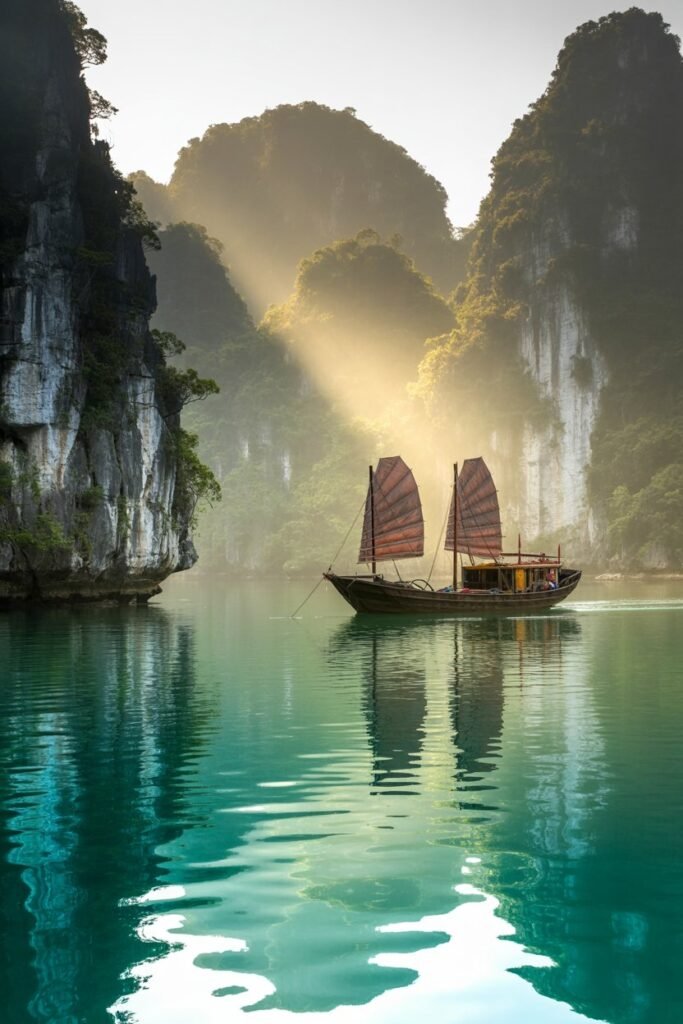
Ha Long Bay was one of those places that instantly made me stop and just breathe.
I was on a small boat, mist curling around limestone karsts that shot up from the jade-green water like ancient sentinels.
The sunlight broke through, sparkling on the waves. Fishermen rowed silently in traditional boats, and floating villages drifted past like tiny islands in a fairy tale.
It didn’t feel like a typical tourist spot it felt sacred.
Ha Long Bay is more than a UNESCO World Heritage site. It’s a place where every turn brings a new wonder, where nature feels deliberate, delicate, and wildly beautiful.
Where Exactly Is Ha Long Bay?
Ha Long Bay is in northeastern Vietnam, in Quang Ninh Province.
The nearest city for travelers is:
- Hanoi (about 3–4 hours by road or shuttle from the bay)
The bay itself consists of around 1,600 limestone islands and islets, many of which are topped with dense jungle vegetation, creating that iconic surreal landscape.
How To Get to Ha Long Bay
Step 1: Travel from Hanoi
Most visitors book a shuttle, private car, or tour from Hanoi. Roads are in good condition, and the drive offers glimpses of rice paddies and small villages.
Step 2: Board a Cruise or Boat
Once at Ha Long Bay, the best way to experience it is by boat:
- Day cruises (4–6 hours)
- Overnight cruises (1–3 nights)
- Private or luxury junks for a more intimate experience
Cruises often include meals, kayaking, and guided stops at hidden caves or beaches.
Why Ha Long Bay Is One of the Most Beautiful Places in the World
Ha Long Bay’s beauty is layered:
- Towering limestone karsts rising dramatically from water
- Hidden grottoes and caves to explore
- Floating villages where fishermen live in harmony with the sea
- Emerald water reflecting the sky and cliffs
Unlike crowded city views, Ha Long Bay feels timeless. It’s serene yet dramatic, peaceful yet endlessly photogenic.
It’s one of those places where you feel both small and incredibly alive.
What To Do in Ha Long Bay
1. Take a Cruise
Choose a cruise that fits your style:
- Luxury cruise: comfortable cabins, guided tours, kayaking, spa
- Budget/standard cruise: simple cabins, authentic local food, quieter experience
Cruises often visit key islands like Ti Top Island, Sung Sot Cave, and floating villages.
2. Kayak Through Hidden Coves
Many tours offer kayaking opportunities, allowing you to explore smaller caves and lagoons unreachable by larger boats.
Paddling quietly gives a sense of solitude, almost like discovering your own secret paradise.
3. Explore Sung Sot Cave (Surprise Cave)
One of the largest and most impressive caves in Ha Long Bay.
It’s full of massive stalactites and stalagmites — an underground world that contrasts perfectly with the bay’s open waters.
4. Visit Floating Villages
Learn about the unique lifestyle of locals living on the water.
- Fish farming is common
- Life moves slowly here
- Respect privacy and always ask before taking photos
It’s a fascinating cultural insight beyond the scenery.
5. Watch Sunrise or Sunset from the Deck
Whether on a cruise or a viewpoint on Ti Top Island, the sunrise over Ha Long Bay is magical.
Sunlight filtering through misty limestone pillars feels almost surreal.
Safety Tips for Ha Long Bay
- Wear life jackets on boats at all times
- Beware of slippery surfaces on docks and boat decks
- If kayaking, avoid going too far from your guide
- Keep an eye on weather; storms can make the bay rough
How To Avoid Tourist Traps
- Book through reputable cruise operators
- Avoid overly cheap “day trips” that cram too many people onto small boats
- Bring your own snacks or water to avoid expensive boat sales
- Choose less crowded routes or overnight cruises for a more peaceful experience
What To Buy in Ha Long Bay
- Handcrafted jewelry made from local pearls
- Traditional Vietnamese conical hats (non-mass produced)
- Lacquerware items
- Local artwork depicting the bay
- Dried seafood snacks (if properly packaged for travel)
Avoid cheap plastic souvenirs sold near tourist docks — they rarely last and aren’t locally made.
Best Time To Visit Ha Long Bay
October to April:
- Cool and dry
- Clear views and calm waters
May to September:
- Warmer and humid
- Occasional storms
- Fewer tourists
Where To Stay
Options range from:
- Luxury cruise ships with cabins and meals included
- Boutique hotels in Ha Long City or nearby Tuan Chau Island
- Budget guesthouses in Ha Long City
If possible, staying on an overnight cruise is the most immersive experience. Waking up surrounded by limestone cliffs is unforgettable.
Personal Reflection
Ha Long Bay made me slow down in a completely different way than the Swiss Alps or Serengeti did.
Here, beauty felt meditative. Silent. Unfolding slowly with every turn of the boat.
I remember sipping tea on the deck of a small wooden junk, watching mist drift past towering cliffs, thinking: “This is exactly how the world should feel sometimes quiet, mysterious, perfect.”
Ha Long Bay doesn’t shout its beauty. It lets you discover it — one quiet moment at a time.
12. The Otherworldly Beauty of Wadi Rum, Jordan
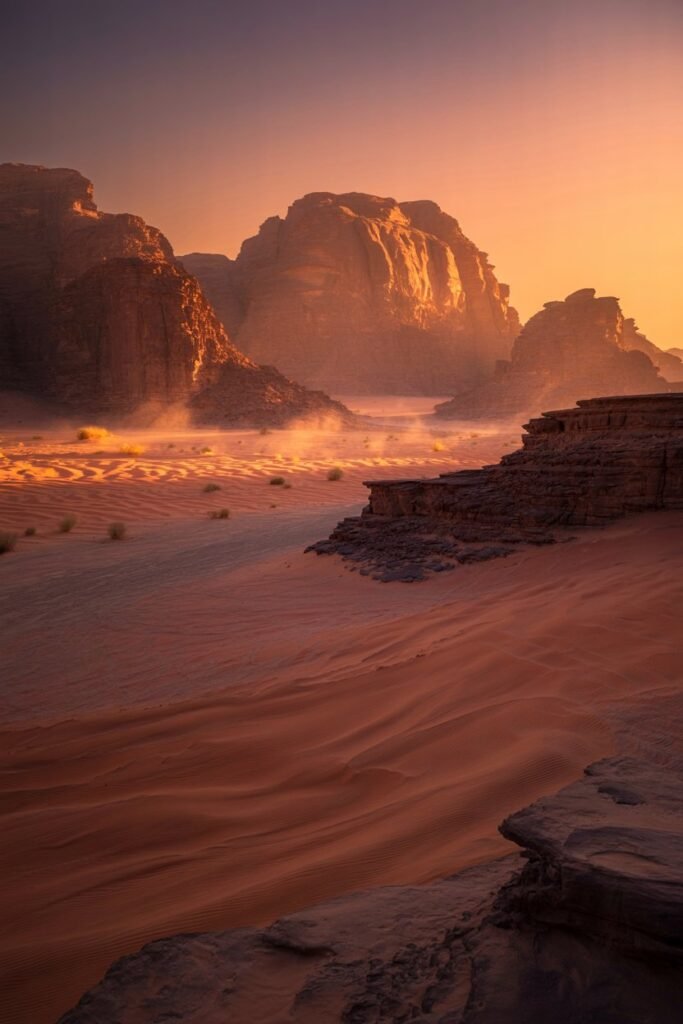
I will never forget the first time I stood in Wadi Rum at sunset.
The sand beneath my shoes glowed burnt orange. Massive sandstone mountains rose around me like frozen waves.
The air felt still almost sacred. And as the sun dipped lower, the entire desert turned shades of gold, copper, and deep red.
It felt like standing on another planet.
Wadi Rum is not just a desert. It is a protected wilderness of towering rock formations, sweeping dunes, ancient petroglyphs, and Bedouin culture that dates back thousands of years. It is raw, cinematic beauty at its finest.
Where Exactly Is Wadi Rum?
Wadi Rum is located in southern Jordan, near the border with Saudi Arabia.
The closest major cities are:
- Aqaba (about 1 hour away)
- Petra (about 1.5 hours away)
Many travelers combine Wadi Rum with Petra and the Dead Sea for a complete Jordan itinerary.
How To Get to Wadi Rum
From Aqaba
Take a taxi or arrange a transfer. The drive takes about one hour and is scenic.
From Petra
Private taxis or tour drivers are common. Expect around 90 minutes by road.
By Organized Tour
Many travelers book a multi-day Jordan tour that includes Wadi Rum, Petra, and sometimes the Dead Sea.
Important: You must enter through the Wadi Rum Visitor Center. From there, your Bedouin host or tour guide will pick you up in a 4×4 vehicle.
Why Wadi Rum Is One of the Most Beautiful Places in the World
Wadi Rum’s beauty feels powerful and untouched.
- Giant sandstone cliffs rise vertically from desert floors.
- Natural rock arches create dramatic silhouettes.
- Endless dunes roll into the horizon.
- The night sky here is one of the clearest I have ever seen.
This is also where movies like The Martian and Lawrence of Arabia were filmed because the landscape looks extraterrestrial.
But beyond its cinematic beauty, Wadi Rum carries deep history. Ancient Nabataean inscriptions and petroglyphs are carved into rocks, reminding you that humans have passed through this desert for thousands of years.
What To Do in Wadi Rum
1. Take a 4×4 Desert Safari
This is the most popular way to explore.
A Bedouin guide will drive you across dunes and through narrow valleys, stopping at:
- Lawrence’s Spring
- Khazali Canyon
- Natural rock bridges
- Ancient carvings
The ride can be bumpy but incredibly thrilling.
2. Stay Overnight in a Desert Camp
If you do only one thing here, make it this.
Desert camps range from simple Bedouin tents to luxury “bubble domes” where you can watch stars from your bed.
At night, you’ll experience:
- Traditional Bedouin dinner cooked underground (Zarb)
- Storytelling around a fire
- Stargazing in near-total darkness
The silence is unlike anything I’ve experienced elsewhere.
3. Camel Ride at Sunset
A short camel ride during golden hour feels timeless.
It slows you down and connects you with how travelers crossed this desert centuries ago.
4. Hike or Scramble Rock Formations
If you enjoy light adventure, you can climb natural arches or hike up dunes for panoramic views.
Always go with a guide for safety.
5. Stargazing
Wadi Rum is a designated dark-sky area. On a clear night, you can see:
- The Milky Way
- Shooting stars
- Countless constellations
Bring a tripod if you love night photography.
Safety Tips for Wadi Rum
- Stay hydrated. Desert heat can be intense.
- Wear sunscreen, a hat, and light breathable clothing.
- Bring layers — nights can get surprisingly cold.
- Always explore with a licensed guide.
- Inform your camp if you plan to hike independently.
The desert can be disorienting if you wander off alone.
How To Avoid Tourist Traps
- Book camps with verified reviews.
- Avoid aggressive touts near the visitor center.
- Confirm what your tour includes (meals, transfers, entry fees).
- Choose smaller group tours for a more authentic experience.
Luxury bubble tents are beautiful, but some are overpriced. Research carefully.
What To Buy in Wadi Rum
Look for locally made items rather than mass-produced souvenirs.
- Handmade Bedouin scarves (keffiyeh)
- Traditional silver jewelry
- Sand art in bottles
- Locally blended spices
Buying directly from Bedouin vendors supports the local community.
Best Time To Visit
March to May and September to November are ideal.
Summer (June–August) can be extremely hot during the day.
Winter nights can drop close to freezing, so pack accordingly.
Where To Stay
Options include:
- Budget Bedouin camps with shared bathrooms
- Mid-range camps with private bathrooms
- Luxury bubble domes with panoramic desert views
If you want a deeply authentic experience, I personally recommend a smaller, family-run Bedouin camp rather than a large commercial one.
Personal Reflection
Wadi Rum changed how I think about silence.
There’s something deeply grounding about standing in a vast desert with nothing but wind and mountains around you. No traffic. No city noise. Just space.
At night, sitting by a fire under an endless sky, I felt small but in a peaceful way. The kind of small that reminds you how big and beautiful the world truly is.
Wadi Rum is not flashy beauty. It is powerful beauty. Raw. Ancient. Unapologetic.
And once you stand in it, you never quite forget how it made you feel.
13. The Wild Atlantic Dream of Faroe Islands
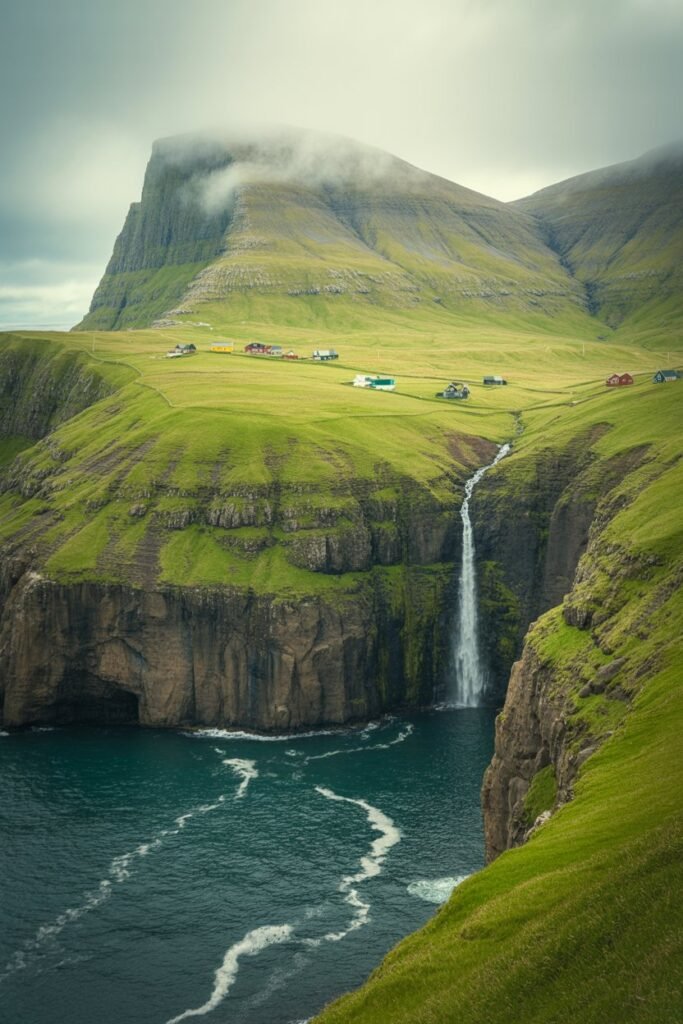
The first time I saw a photo of the Faroe Islands, I genuinely thought it was edited.
Sheer green cliffs dropped straight into the ocean. Tiny turf-roofed houses clung to hillsides. Waterfalls spilled into the sea like silver ribbons. It looked too dramatic to be real.
And yet, when I finally stood there, wind whipping through my hair, breathing in that salty Atlantic air, it was even more beautiful in person.
The Faroe Islands are remote, wild, and unapologetically raw. If you love landscapes that make you feel tiny and alive all at once, this place will stay with you forever.
Where Exactly Are the Faroe Islands?
The Faroe Islands are located in the North Atlantic Ocean between Iceland and Norway. They are an autonomous territory within the Kingdom of Denmark.
The capital city is:
- Tórshavn
The islands consist of 18 volcanic islands connected by tunnels, ferries, and bridges.
How To Get There
Most international travelers fly into:
- Vágar Airport
Flights typically connect through Copenhagen or other Scandinavian cities.
From the airport, you can rent a car (highly recommended) and drive through undersea tunnels that connect the islands. Driving here feels like part of the adventure.
Why The Faroe Islands Are One of the Most Beautiful Places in the World
The beauty here feels untouched.
- Cliffs that rise hundreds of meters above roaring waves
- Endless rolling green hills
- Dramatic sea stacks and rugged coastlines
- Tiny villages with colorful houses
Unlike more commercial destinations, the Faroe Islands still feel authentic. Nature dominates everything. The weather changes by the minute, adding mood and mystery to every view.
You won’t find massive resorts or flashy nightlife. You will find silence, wind, waterfalls, and landscapes that look like fantasy movie sets.
What To Do in the Faroe Islands
1. Hike to Lake Sørvágsvatn
Also known as the “floating lake,” this optical illusion makes it appear as though the lake sits above the ocean.
The hike takes about 2–3 hours round trip. The final viewpoint overlooking the Atlantic is breathtaking.
Tip: Stay on marked trails and respect local farmland.
2. Visit the Village of Saksun
A tiny village surrounded by dramatic mountains and a tidal lagoon. It feels like stepping into a Nordic fairytale.
Walk around slowly. The silence here is powerful.
3. See the Møllafossur Waterfall
One of the most iconic views in the country. A waterfall plunges off a cliff into the Atlantic with a small village nearby.
Sunset here is unreal — if the weather cooperates.
4. Explore Tórshavn
The capital is charming and compact.
- Wander the old town of Tinganes
- Visit small Nordic cafés
- Try traditional Faroese dishes like fermented lamb or fresh seafood
It’s quiet but cozy.
5. Drive the Undersea Tunnels
Yes, this is actually an experience.
The tunnels connecting islands are carved through mountains and under the ocean. One even features a glowing art installation inside.
Driving through them feels surreal.
Safety Tips
- Weather changes rapidly. Always check forecasts before hiking.
- Wear waterproof layers and sturdy boots.
- Stay back from cliff edges — winds can be extremely strong.
- Avoid hiking alone in remote areas if you’re inexperienced.
Nature here is powerful and should be respected.
How To Avoid Tourist Traps
The Faroe Islands aren’t overly commercialized, but:
- Avoid paying for unofficial “parking” spots near popular hikes.
- Book licensed guides for boat tours.
- Support local restaurants instead of imported fast food.
Most importantly, respect local communities — some hiking trails cross private land and require small access fees. Pay them. It helps preserve the environment.
What To Buy in the Faroe Islands
If you want something meaningful:
- Hand-knit Faroese wool sweaters
- Locally made scarves
- Faroese sea salt
- Nordic ceramics
- Art prints of the landscapes
Avoid cheap imported souvenirs. The handmade wool pieces may be expensive, but they last for years and truly represent the culture.
Best Time To Visit
May to September is ideal.
Summer offers:
- Longer daylight hours
- Slightly warmer temperatures
- Better hiking conditions
Winter is dramatic and beautiful but dark and stormy, making travel more challenging.
Where To Stay
Options include:
- Cozy guesthouses in villages
- Boutique hotels in Tórshavn
- Remote cabins overlooking cliffs
I recommend staying outside the capital for at least part of your trip to experience true Faroese serenity.
Personal Reflection
The Faroe Islands taught me to slow down.
The wind forces you to pause. The silence demands your attention. The weather reminds you that you’re not in control.
I remember standing on a cliff, waves crashing far below, fog rolling in like a moving curtain. For a moment, it felt like the world had shrunk to just me and the ocean.
It wasn’t loud beauty. It wasn’t flashy.
It was wild, moody, and unforgettable.
14. The Turquoise Paradise of Phi Phi Islands, Thailand
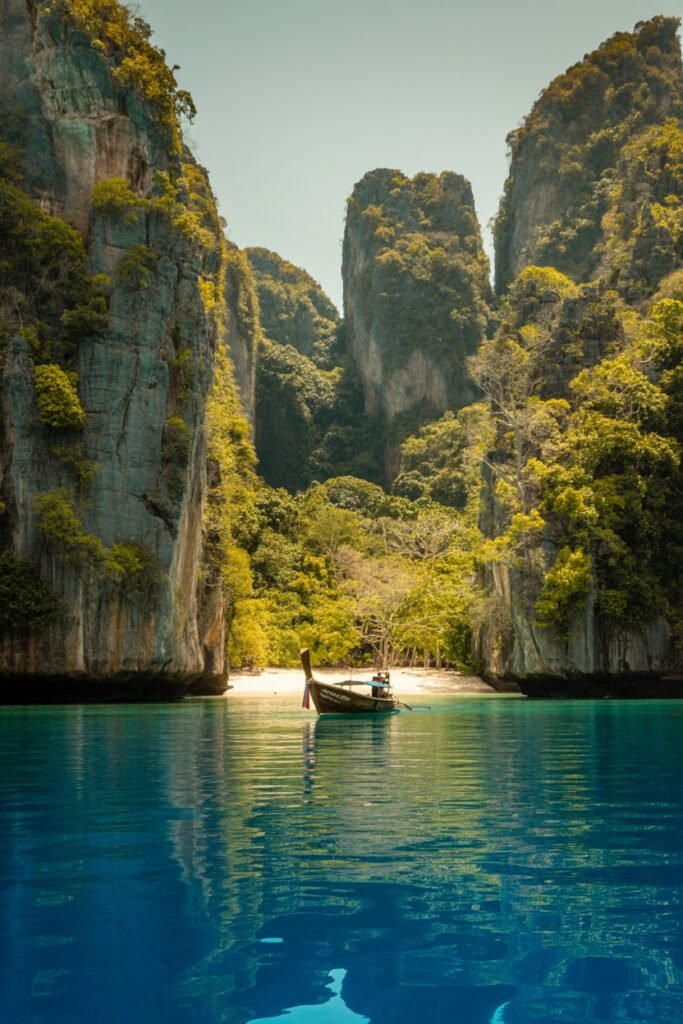
I remember stepping off the boat and feeling like I had walked straight into a postcard.
The water was so clear I could see fish swimming around my ankles. Limestone cliffs rose dramatically from the sea, wrapped in lush greenery. The air smelled like salt and sunshine. And for a moment, everything felt light and carefree.
The Phi Phi Islands are the kind of place you visit when you want tropical beauty that feels cinematic but you also need to know how to experience them the right way to truly appreciate their magic.
Where Exactly Are the Phi Phi Islands?
The Phi Phi Islands are located in the Andaman Sea in southern Thailand, between Phuket and Krabi.
The main inhabited island is:
- Ko Phi Phi Don
The famous uninhabited island known for its turquoise lagoon is:
- Ko Phi Phi Le
How To Get There
You cannot fly directly to the Phi Phi Islands.
Step 1: Fly Into
- Phuket
or - Krabi
Step 2: Take a Ferry or Speedboat
From either Phuket or Krabi, ferries run daily and take about 1.5–2 hours.
If you want a smoother ride, book an early morning departure when the sea is calmer.
Important: There are no cars on Phi Phi Don. Everything is walkable or accessed by boat.
Why The Phi Phi Islands Are One of the Most Beautiful Places in the World
The beauty here is bold and bright.
- Water in shades of turquoise and emerald
- Dramatic limestone cliffs
- White sandy beaches
- Snorkeling spots full of marine life
One of the most iconic spots is Maya Bay, which gained worldwide attention after being featured in The Beach.
But beyond the famous beaches, it’s the surrounding smaller coves, hidden lagoons, and sunset viewpoints that make Phi Phi truly breathtaking.
What To Do in the Phi Phi Islands
1. Visit Maya Bay (Early Morning Only)
Maya Bay on Phi Phi Le is stunning — but timing matters.
Go as early as possible to avoid crowds. The bay has limited visitor numbers to protect the ecosystem.
Swimming restrictions sometimes apply to preserve coral reefs.
2. Snorkel Around Bamboo Island
Clear waters and vibrant fish make this one of the best snorkeling areas in the region.
Bring reef-safe sunscreen to protect marine life.
3. Hike to the Phi Phi Viewpoint
This is one of the best panoramic views in Thailand.
The short but steep hike rewards you with a stunning view of the twin bays of Phi Phi Don.
Go at sunrise or sunset for cooler temperatures and softer light.
4. Take a Private Longtail Boat Tour
Instead of booking a large group tour, consider hiring a private longtail boat for a few hours.
It allows you to:
- Avoid crowds
- Visit hidden beaches
- Stop for swimming whenever you like
It’s more personal and often more relaxing.
5. Kayak Around the Cliffs
Renting a kayak lets you explore caves and quiet coves at your own pace.
The water is usually calm enough for beginners.
Safety Tips
- Always check weather conditions before boat trips.
- Wear proper footwear — paths can be uneven.
- Stay hydrated in the tropical heat.
- Avoid excessive alcohol near cliffs or boats.
- Respect swimming boundaries to protect coral reefs.
The sun here is intense. Reapply sunscreen frequently.
How To Avoid Tourist Traps
Phi Phi can be crowded if you’re not strategic.
- Avoid midday tours to Maya Bay.
- Stay slightly outside the main Tonsai area for quieter accommodation.
- Book boat tours directly with local operators rather than random beach sellers.
- Compare prices — some vendors overcharge tourists.
The beauty is still here, but timing and planning are everything.
What To Buy in the Phi Phi Islands
- Handmade shell jewelry (ensure it’s sustainably sourced)
- Thai silk scarves
- Coconut oil skincare products
- Locally made beachwear
- Thai spices or curry paste (pack safely)
Avoid buying coral or marine life souvenirs — they are illegal and harmful to ecosystems.
Best Time To Visit
November to April is the best season.
- Dry weather
- Calm seas
- Clear skies
May to October is rainy season, but you may find cheaper prices and fewer tourists.
Where To Stay
Options include:
- Beachfront resorts
- Budget guesthouses
- Boutique hillside hotels with ocean views
For a quieter experience, choose accommodation away from the main party zone of Tonsai Village.
Personal Reflection
Phi Phi surprised me.
Yes, it’s famous. Yes, it’s popular. But when you find a quiet cove, when you swim in water so clear it looks unreal, when you sit on a longtail boat watching the sun melt into the sea — it feels deeply personal.
I remember floating in warm turquoise water, staring up at cliffs towering above me, thinking, “This is why people fall in love with travel.”
It’s bright. It’s beautiful. It’s tropical magic done right if you move thoughtfully and explore beyond the obvious.
15. The Majestic Peaks of Banff National Park, Canada
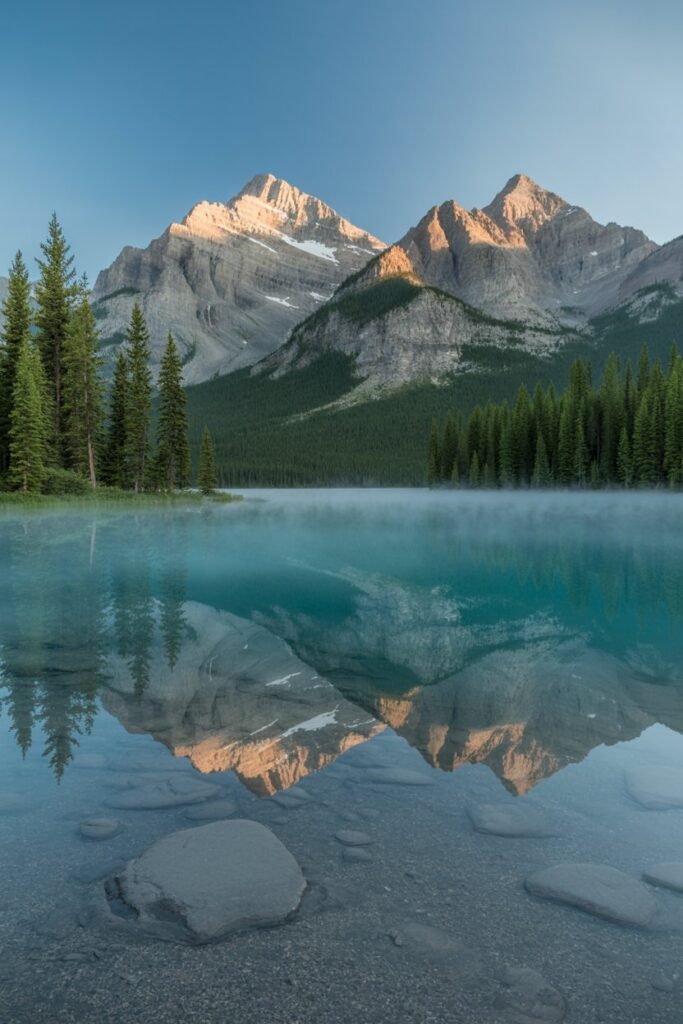
The first time I saw the water at Lake Louise, I genuinely thought someone had edited the color.
It wasn’t just blue. It was an almost glowing turquoise the kind of color that feels impossible in real life. Behind it, towering Rocky Mountain peaks stood sharp and proud, snow clinging to their tops even in summer.
The air was crisp, clean, and cold enough to make you feel awake in a way you didn’t know you needed.
Banff isn’t quiet tropical beauty.
It’s powerful, alpine, cinematic beauty.
And it stays with you long after you leave.
Where Exactly Is Banff National Park?
Banff National Park is located in Alberta, western Canada, within the Canadian Rockies.
The closest major airport is:
- Calgary (about 1.5 hours by car)
The park itself includes famous areas like:
- Lake Louise
- Moraine Lake
- Banff
How To Get There
Step 1: Fly Into Calgary
Calgary International Airport is the main gateway.
Step 2: Drive to Banff
Renting a car is highly recommended. The drive from Calgary to Banff along the Trans-Canada Highway is scenic and easy.
Alternatively:
- You can take a shuttle from Calgary Airport.
- Some hotels offer transfers.
- Guided tours operate daily from Calgary and Banff town.
A Parks Canada pass is required for entry into Banff National Park.
Why Banff Is One of the Most Beautiful Places in the World
Banff feels almost unreal.
- Glacier-fed lakes glowing turquoise
- Snow-capped mountain peaks
- Wildflower meadows in summer
- Frozen waterfalls in winter
- Wildlife like elk and mountain goats roaming freely
The scale of the landscape is what truly moves you. Everything feels big. Expansive. Raw.
And yet, it’s accessible. You can stand in front of one of the most beautiful lakes in the world without hiking for days.
What To Do in Banff National Park
1. Visit Lake Louise
Arrive early — ideally before 7 a.m.
Walk the lakeshore trail or hike to Lake Agnes Tea House for panoramic views. Canoeing on the lake is also unforgettable.
2. See Moraine Lake
This is one of the most photographed lakes in the world.
Important: Access is limited. You often need to book a shuttle in advance, as private vehicles are restricted.
The Ten Peaks behind the lake create one of the most iconic mountain backdrops anywhere on earth.
3. Drive the Icefields Parkway
This scenic highway between Lake Louise and Jasper is one of the most beautiful drives in the world.
Expect:
- Glaciers
- Waterfalls
- Wildlife sightings
- Scenic viewpoints
Stop frequently every few minutes there’s another jaw-dropping view.
4. Take the Banff Gondola
Ride up Sulphur Mountain for sweeping views over Banff town and the surrounding Rockies.
Go around sunset for the most magical lighting.
5. Soak in Banff Upper Hot Springs
After hiking, soaking in warm mineral water while surrounded by mountains feels heavenly.
6. Wildlife Watching
You may see:
- Elk
- Deer
- Bighorn sheep
- Bears (from a safe distance)
Always keep at least 100 meters from bears and 30 meters from other wildlife.
Safety Tips
- Carry bear spray when hiking.
- Check trail conditions before heading out.
- Dress in layers — weather can change quickly.
- Never approach wildlife for photos.
- Stay on marked trails.
Banff is safe but wild. Respect the environment.
How To Avoid Tourist Traps
Banff is popular, especially in summer.
- Arrive early to major lakes.
- Visit shoulder seasons (May or September).
- Book accommodations months in advance.
- Skip overpriced gift shops in favor of local artisan stores.
- Explore lesser-known hikes instead of only the most famous spots.
Early mornings are your secret weapon here.
What To Buy in Banff
- Locally made maple syrup products
- Indigenous art (from verified authentic sellers)
- Canadian wool blankets
- Handcrafted mountain jewelry
- Outdoor gear from Canadian brands
Avoid cheap imported souvenirs labeled “Canadian” but mass-produced elsewhere.
Best Time To Visit
June to September:
- Hiking season
- Accessible trails
- Vibrant blue lakes
October:
- Fewer crowds
- Golden larch trees
December to March:
- Snow-covered landscapes
- Skiing
- Frozen lakes
Each season feels like a different destination.
Where To Stay
Options range from:
- Luxury mountain lodges
- Boutique hotels in Banff town
- Cozy cabins
- Budget hostels
If possible, stay inside the park for easier early access to lakes.
Personal Reflection
Banff made me feel small but in the best possible way.
Standing in front of Moraine Lake, I remember feeling quiet inside. No rush. No noise. Just mountains towering above and water glowing below.
It reminded me that the world is vast. That there are still places that take your breath away without trying too hard.
And that kind of beauty? It stays with you.
Conclusion: The World Is More Beautiful Than We Remember
Writing this list made me emotional in a way I didn’t expect.
Because when I think about these places from the glowing turquoise waters of Banff National Park to the silent red sands of Wadi Rum, from the dramatic cliffs of the Faroe Islands to the emerald waters of Ha Long Bay I don’t just remember how they looked.
I remember how they felt.
I remember the stillness.
The awe.
The way my heart slowed down for a moment.
The way I realized the world is far bigger and far more beautiful than my everyday routine.
And that’s what I truly want for you.
Not just pretty photos.
Not just bucket-list checkmarks.
But moments that shift something inside you.
Traveling to the most beautiful places in the world isn’t about chasing perfection. It’s about perspective. It’s about standing in front of something so breathtaking that your worries feel smaller.
It’s about realizing how diverse and magnificent this planet really is from deserts to glaciers, islands to mountains, oceans to remote villages.
But here’s something equally important: beauty deserves respect.
When you visit these places:
- Choose responsible tour operators.
- Support local businesses.
- Respect wildlife and cultural traditions.
- Avoid shortcuts that harm the environment.
- Leave every place better than you found it.
Because these destinations aren’t just “Instagram spots.” They are homes. Ecosystems. Sacred lands. Stories passed down through generations.
And if you travel thoughtfully, you don’t just see the world you connect with it.
If there’s one thing I’ve learned from experiencing some of the most beautiful places on Earth, it’s this:
The world will always surprise you.
Just when you think you’ve seen the bluest water, you’ll find something brighter. Just when you think you’ve stood in the most dramatic landscape, another one will take your breath away. Just when you think you understand beauty, nature will redefine it for you.
So dream big.
Start saving.
Pick one place from this list and commit to it.
Because the world is waiting not just to be seen, but to be felt.
And I promise you this: the memories you make in places like these will stay with you long after your suitcase is unpacked.
Now tell me…
Which of these beautiful places is calling your name first?